PURSUE/sandia-green-fireballs-1948-1950 / 1948-1950 / PURSUE / Department of War
DOW-UAP-D017 — The Sandia Base Green Fireball File: New Mexico Aerial Phenomena, 1948-1950
PURSUE / Department of War (1948). DOW-UAP-D017 — The Sandia Base Green Fireball File: New Mexico Aerial Phenomena, 1948-1950. The UFO Files. https://the-ufo-files-site.netlify.app/dossier/sandia-green-fireballs-1948-1950
"DOW-UAP-D017 — The Sandia Base Green Fireball File: New Mexico Aerial Phenomena, 1948-1950." PURSUE / Department of War. 1948. https://the-ufo-files-site.netlify.app/dossier/sandia-green-fireballs-1948-1950.
DOW-UAP-D017 — The Sandia Base Green Fireball File: New Mexico Aerial Phenomena, 1948-1950
Case ID: PURSUE/sandia-green-fireballs-1948-1950
Agency: PURSUE / Department of War
Date: 1948-1950
Source: https://www.war.gov/UFO/?releaseDate=Release+02#records
Mirrored on The UFO Files, an archive by Dead Pixel Design. The file is the file. Anything in question is one click from the original.
Summary
A 116-page declassified correspondence folder titled “General Correspondence of Sandia Base, Folder 333,” released in PURSUE Release 02 as DOW-UAP-D017. War.gov describes it as “a collection of UAP reports and documents from a national security site in New Mexico 1948-1950.” That description undersells it. This is a substantial chunk of the original green fireball investigation file — the late-1940s effort, centered on Sandia Base, Los Alamos, and Kirtland/Holloman, to explain a wave of bright green, silent, low, horizontally-moving “fireballs” and disc sightings clustering over the most sensitive nuclear installations in the United States.
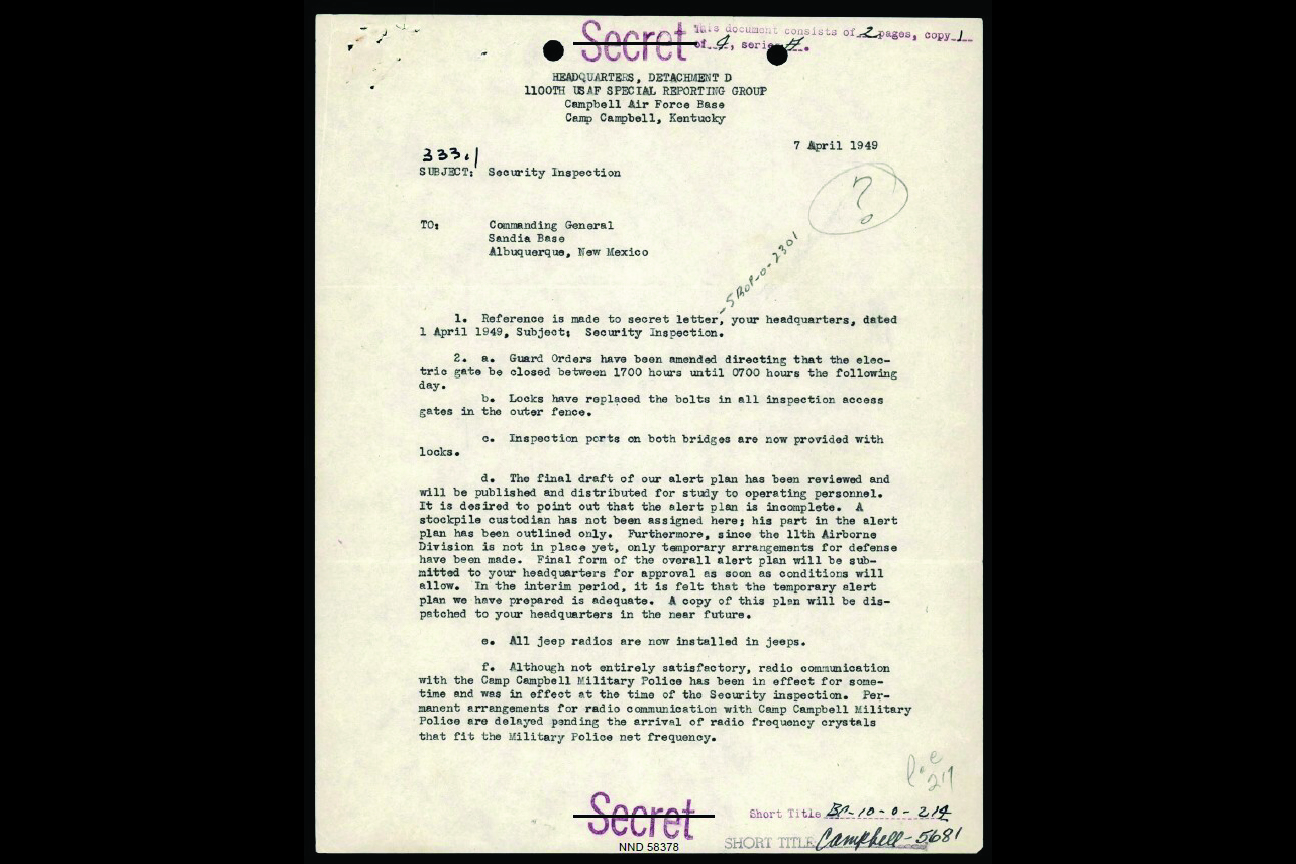
The folder opens with routine base-security correspondence (a 7 April 1949 security-inspection reply from Detachment D, 1100th USAF Special Reporting Group at Camp Campbell to the Commanding General, Sandia Base) and then turns into the documentary record of the green fireball problem: Dr. Lincoln La Paz’s analyses, the Office of Special Investigations (OSI) 17th District summary of New Mexico aerial phenomena, a multi-page tabular catalog of sightings, the copper-particle collection experiment after the 24 July 1949 Socorro fireball, and the contract that became the precursor to Project Twinkle.
Declassification markings throughout: NND 58378 (the AFSWP/base-security portion) and NW 91526 (the OSI/La Paz aerial-phenomena portion).
What’s In the Folder
1. The 25 May 1950 OSI Summary (the centerpiece)
A CONFIDENTIAL summary, “Observations of Aerial Phenomena in the New Mexico Area, December 1948 - May 1950,” addressed to Brigadier General Joseph F. Carroll, Director of Special Investigations, Headquarters USAF, signed by Lt. Col. Doyle Rees, District Commander, 17th District OSI. Its framing is unambiguous:
“In a liaison meeting with other military and government intelligence and investigative agencies in December 1948, it was determined that the frequency of unexplained aerial phenomena in the New Mexico area was such that an organized plan of reporting these observations should be undertaken.”
The summary classifies each sighting into one of three buckets: (1) green fireball phenomenon, (2) disc or variation, and (3) probably meteoric. Its observers are explicitly credentialed:
“The observers of these phenomena include scientists, Special Agents of the Office of Special Investigations (IG) USAF, airline pilots, military pilots, Los Alamos Security Inspectors, military personnel, and many other persons of various occupations whose reliability is not questioned.”
It records that conferences were held at Los Alamos on 17 February 1949 and 14 October 1949 with representatives of the Fourth Army, the Armed Forces Special Weapons Project (AFSWP), the University of New Mexico, the FBI, the U.S. Atomic Energy Commission, the University of California, the USAF Scientific Advisory Board, the Geophysical Research Division of Air Materiel Command, and OSI. The conclusion:
“A logical explanation was not proffered with respect to the origin of the green fireballs. It was, however, generally concluded that the phenomena existed and that they should be studied scientifically until these occurrences have been satisfactorily explained. Further, that the continued occurrence of unexplained phenomena of this nature in the vicinity of sensitive installations is cause for concern.”
The summary’s enclosures are listed as: a Summary of Sightings, a photo of Sighting No. 175 with comments, a 23 May 1950 letter from Dr. La Paz to Lt. Col. Rees, and a graph indicating maximums.
2. The Sightings Catalog
A multi-page tabular “Summary of Sightings of Unknown Aerial Phenomena, 17th District OSI,” running roughly 30 OCR pages. The table records date, time, location, direction, color, shape (including entries explicitly logged as “Disc”), duration, and classification per sighting, numbered up through at least Sighting No. 175. The OCR mangles the table grid badly (it is a scanned form), so individual rows should be read against the original scan rather than the transcript; the structure, classifications, and the No. 175 reference are legible.
3. Dr. Lincoln La Paz’s Analysis
La Paz — Director of the Institute of Meteoritics and head of Mathematics and Astronomy at the University of New Mexico, a former research mathematician at the New Mexico Proving Grounds and Technical Director of the Operations Analysis Section at Second Air Force — served as the district’s volunteer green-fireball consultant. His 23 May 1950 letter, “Anomalous Luminous Phenomena (Seventh Report),” restates the ten ways the December 1948 green fireballs differed from ordinary meteors, including:
“(1) The horizontal nature of the paths of most of the December fireballs is most unusual. Genuine meteors are rarely observed to move in horizontal paths.”
“(4) In the case of meteorites that penetrate to as low levels as that determined for the fireball of December 12, the observed luminous phenomena are always accompanied by very violent noises. No noises whatever have been observed in connection with the various December fireballs so far investigated.”
“(5) … In the case of the December fireballs most of the observers have reported that the green balls appeared almost instantly at their full brightness.”
“(6) … in the case of the green fireballs, plots of admissible approach sectors show that there is a very pronounced tendency for the paths to come in from the north half of the sky.”
4. The 24 July 1949 Socorro Fireball and the Copper-Particle Experiment
A report by D. Crozier and Ben K. Seely, “An Attempt to Collect Airborne Particles Associated with the Fireball of July 24, 1949.” A fireball passed near Socorro, New Mexico at 8:26 p.m. on 24 July 1949. Using aerosol-impactment equipment from the New Mexico School of Mines, the team collected airborne particles starting ~13.5 hours later and found particles giving “positive copper tests,” some up to over one hundred microns. The copper-content question — whether green fireballs were dropping copper-bearing material, which would make them “not conventional meteorites” — runs through several documents in the folder.
5. The Land-Air / Holloman Contract (Project Twinkle Precursor)
“The Geophysical Research Division, Air Materiel Command, Cambridge, Massachusetts, has recently let a contract to Land-Air, Inc., Holloman AFB, Alamogordo, New Mexico, for a limited scientific study of green fireballs.”
This is the instrumented-observation effort that became Project Twinkle, the official 1950-51 photographic and spectrographic study of the New Mexico fireballs.
Why This Document Matters
- Provenance. This is not a retrospective writeup of the green fireball era; it is the contemporaneous government file, on Sandia Base letterhead, with period classification markings and the named officers (Rees, Carroll) and scientist (La Paz) who ran the problem. It is primary source material for one of the foundational episodes in US government UFO history.
- The pattern is the point. The recurring theme of both PURSUE releases — anomalous aerial activity over nuclear and weapons installations — has its documentary origin here. The 1950 OSI summary states the concern plainly: unexplained phenomena “occurring in the vicinity of sensitive military and government installations.” Seventy-five years later the USPER narrative in this same release describes orbs over a weapons test range.
- It connects directly to the existing archive. Project Twinkle, Los Alamos/Sandia overflights, and AEC-installation concern are already documented in the FBI 62-HQ-83894 archive. DOW-UAP-D017 is the AFSWP/OSI side of the same story the FBI file tells from the Bureau’s side.
Caveats
- The folder is “general correspondence.” A meaningful fraction of its 116 pages is routine base administration (erosion control, gate locks, radio crystals) with no UAP content. The aerial-phenomena material is the high-signal subset, not the whole folder.
- The OCR of the scanned sightings table is severely degraded. Quantitative claims about individual table rows must be verified against the original scan.
- Nothing in this file resolves the green fireballs. La Paz argued they were non-meteoric; others (notably Dr. Joseph Kaplan and, later, the broader Air Force) leaned toward natural explanations. The file documents an open question, not an answer.
- Quotes above are taken from the cleaner passages of the OCR transcript and corrected only for obvious scanning artifacts; bracketed insertions mark editorial clarifications.
Provenance
- Document ID: DOW-UAP-D017 (source PDF title: “374_141326_General_Correspondence_of_Sandia_Base_Folder_333”; 116 pages)
- Official source: U.S. Department of War, PURSUE Release 02, cleared for release May 22, 2026. Release 02 records.
- Release announcement: DOW press release, May 22, 2026.
- Document bundle (official): release_02_document_bundle.zip (70.1 MB).
- Preview image (official): DOW-UAP-D017 slideshow image.
- Declassification markings: NND 58378; NW 91526.
- Local OCR transcript:
raw/pursue-release-02-ocr/DOW-UAP-D017.txt(716 KB).
Connections
- James Tuck correspondence (DOE-UAP-D002) — Los Alamos physicist on atmospheric vortices and the Condon Report
- Pajarito Astronomers 1986 (DOE-UAP-D003) — Los Alamos scientists still discussing UFOs decades later
- CIA Sary Shagan green object (CIA-UAP-D001) — green-mass phenomenology over a weapons range
- USPER narrative (ODNI-UAP-D001) — modern orbs over a weapons range
- FBI 62-HQ-83894 master report — the Bureau’s side of the same era
- PURSUE program
- Release 02 full inventory
- Release 02 master report
Open Questions
- How much of the original green fireball file does DOW-UAP-D017 represent, and is the rest of “Folder 333” (or adjacent folders) coming in a later tranche?
- Did the copper-particle finding ever get a definitive resolution, or was it left hanging as the file suggests?
- The folder lists “Photo of Sighting No. 175” as an enclosure. Is that photograph in the release, and if not, where is it?
- How does this file’s sighting catalog overlap with the Project Twinkle records and the FBI 62-HQ-83894 New Mexico material already in the archive?