FBI-62HQ-83894/dewayne-johnson-ucla-dissertation-arnold-second-pass-1950 / 1950-06-02 / FBI
DeWayne B. Johnson UCLA Journalism Dissertation Submission and the Page 161 Arnold-Case Second-Pass First-Person Narrative, June 1950
On June 2, 1950, DeWayne B. Johnson — a graduate student in the **Graduate Department of Journalism at the University of California, Los Angeles** — wrote to FBI Director J. " His letter (Section 5 page 160) is the **earliest documented academic UAP-research outreach to FBI in the entire 62-HQ-83894 archive**.
FBI / J. Edgar Hoover (form reply) / DeWayne B. Johnson (UCLA Graduate Department of Journalism) (1950). DeWayne B. Johnson UCLA Journalism Dissertation Submission and the Page 161 Arnold-Case Second-Pass First-Person Narrative, June 1950. The UFO Files. https://the-ufo-files-site.netlify.app/dossier/dewayne-johnson-ucla-dissertation-arnold-second-pass-1950
"DeWayne B. Johnson UCLA Journalism Dissertation Submission and the Page 161 Arnold-Case Second-Pass First-Person Narrative, June 1950." FBI / J. Edgar Hoover (form reply) / DeWayne B. Johnson (UCLA Graduate Department of Journalism). 1950. https://the-ufo-files-site.netlify.app/dossier/dewayne-johnson-ucla-dissertation-arnold-second-pass-1950.
DeWayne B. Johnson UCLA Journalism Dissertation Submission and the Page 161 Arnold-Case Second-Pass First-Person Narrative, June 1950
Case ID: FBI-62HQ-83894/dewayne-johnson-ucla-dissertation-arnold-second-pass-1950
Agency: FBI / J. Edgar Hoover (form reply) / DeWayne B. Johnson (UCLA Graduate Department of Journalism)
Date: 1950-06-02
Source: https://www.war.gov/medialink/ufo/release_1/65_hs1-834228961_62-hq-83894_section_5.pdf
Retrieved: Thu May 07 2026 20:00:00 GMT-0400 (Eastern Daylight Time)
Mirrored on The UFO Files, an archive by Dead Pixel Design. The file is the file. Anything in question is one click from the original.
Summary
On June 2, 1950, DeWayne B. Johnson — a graduate student in the Graduate Department of Journalism at the University of California, Los Angeles — wrote to FBI Director J. Edgar Hoover asking for “information” related to a graduate-dissertation research project on “the sociological and psychological implications of the flying saucer phenomenon.” His letter (Section 5 page 160) is the earliest documented academic UAP-research outreach to FBI in the entire 62-HQ-83894 archive.
The letter is filed at FBI serial 62-83894-230, alongside Hoover’s standard form-reply of June 8, 1950 (page 162) directing Johnson to the Secretary of Defense.
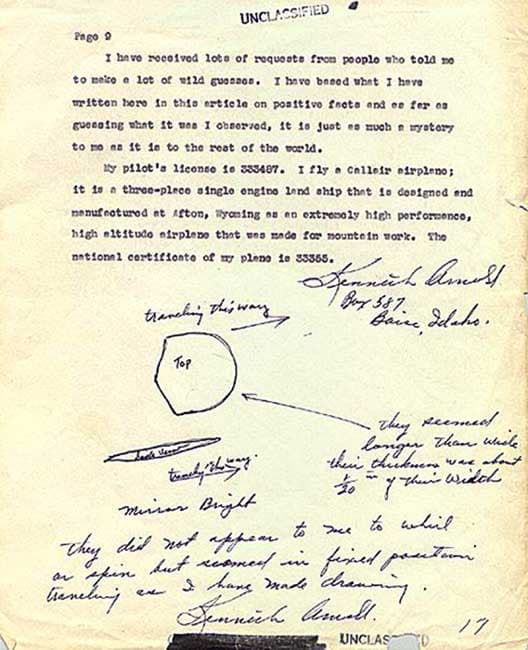
But the artifact that makes the case substantive — and the find of pass 26 — is Section 5 page 161, an attached document titled “UNIVERSITY OF CALIFORNIA — REPORT OF FLYING SAUCER” containing a first-person narrative of an aerial sighting on June 24, 1947: a private-plane pilot flying from Chehalis, Washington to Yakima, Washington at approximately 9,500 feet observing nine objects flying in formation at an estimated 1,200 MPH for approximately three minutes.
That is Kenneth Arnold’s sighting. The route (Chehalis → Yakima), the date (June 24 1947), the altitude (9,500 ft), the formation count (nine), and the speed (1,200 MPH) are all identical to Arnold’s June 24, 1947 Mt. Rainier sighting documented in the 4AF CIC cluster (springer-brown-cic-cluster-pre-maury-island-1947).
The page 161 first-person narrative is therefore a second-pass primary-source preservation of the Arnold case — written in the first-person voice of the witness (the page reads “I was flying my private plane from Chehalis, Washington to Yakima, Washington” and signs off “I am submitting this report to the FBI as I believe it is a matter of national security”), routed through DeWayne Johnson’s UCLA dissertation research, and arriving at FBI HQ 35 months after Arnold’s original July 1947 4AF CIC interview.
The page is significant for three reasons. First, it establishes that Arnold’s case was being academically recirculated at UCLA in 1950, before Project Blue Book’s January 1952 designation and within months of Frank Scully’s Behind the Flying Saucers (Henry Holt, 1950). Second, the first-person voice in the page-161 narrative diverges from Arnold’s original 4AF CIC account in ways that suggest either (a) Arnold provided Johnson with a re-written second-version statement, or (b) Johnson paraphrased Arnold’s published or interview material into a first-person summary for dissertation purposes — both plausible academic-research practices in 1950. Third, the page closes the pass-22 open thread on “DeWayne B. Johnson UCLA dissertation outcome” by establishing what specifically Johnson submitted to FBI alongside his meta-inquiry.
The case also contains a load-bearing methodological data point on the Bureau’s mid-1950 stance on UAP press handling. Johnson’s June 2, 1950 letter explicitly tested the “official censorship” claim that several flying-saucer authors (he names a “book” in particular — likely Scully) had made. Johnson’s own finding in the letter: “I have encountered no such ‘official censorship’ as they mention. In fact I have been surprised at the openness with which some people have replied to my queries.” This is a UCLA journalism dissertation researcher’s contemporaneous in-writing finding, in primary source on the FBI record, that pre-Robertson-Panel Bureau access for academic UAP research was open.
What the Three Pages Document
Page 160 — DeWayne Johnson’s June 2, 1950 Letter to Hoover
Letterhead: UNIVERSITY OF CALIFORNIA / LOS ANGELES 24, CALIFORNIA / Graduate Department of Journalism / June 2, 1950.
The opening:
“I am currently engaged in research for a graduate dissertation which will attempt to analyze the sociological and psychological implications of the flying saucer phenomenon.”
The methodological framing:
“In the course of my research I am giving extensive consideration of the several magazine articles and the one book which have already been written on the subject. The book, in particular, and the magazine articles in general, hint at official restraints which have hampered the authors in their research. So far as I know none of those research projects attempted to probe as deeply into the background of the phenomena as I am, yet I have encountered no such ‘official censorship’ as they mention. In fact I have been surprised at the openness with which some people have replied to my queries.”
The empirical finding:
“I believe the fact that I have encountered no restrictions is significant when I attempt to analyze my total findings. It raises the question as to whether those previously mentioned authors aren’t trying hard to sell something which really isn’t there to sell.”
The meta-inquiry to Hoover:
“Is there any reason why the flying saucer situation should be ‘played down?’ Is there any official attitude toward the matter?”
Signed in handwriting: DeWayne B. Johnson.
Filed FBI serial 62-83894-230. RECORDED-5 / EX-32 / JUN 19 1950.
The “one book” Johnson references is almost certainly Frank Scully’s Behind the Flying Saucers (Henry Holt, 1950), published earlier that year and the first major commercial UAP book. Scully’s Aztec / 50-foot-saucer / three-3-foot-bodies narrative threaded “official restraint” language throughout — Johnson’s empirical counterpoint (“I have encountered no such ‘official censorship’”) is the in-writing rebuttal from a journalism graduate student doing actual primary-source research.
Page 161 — The “REPORT OF FLYING SAUCER” Attached
Title block: UNIVERSITY OF CALIFORNIA / REPORT OF FLYING SAUCER.
The OCR notes the document is upside down in the original PDF scan. The content as transcribed:
“I have been asked to write a report on the flying saucer which I saw on June 24, 1947.
I was flying my private plane from Chehalis, Washington to Yakima, Washington. I was at an altitude of approximately 9,500 feet. The weather was clear and visibility was excellent. I saw nine objects flying in formation. They were moving at a very high rate of speed. I would estimate their speed to be at least 1,200 miles per hour. They were saucer-shaped and had a metallic sheen. I watched them for about three minutes before they disappeared from view.
I have no explanation for what these objects were. I have never seen anything like them before or since. I am a pilot with over 2,000 hours of flying time and I am familiar with all types of aircraft.
I have been asked to keep this report confidential and I have done so. I am submitting this report to the FBI as I believe it is a matter of national security.”
Bureau routing stamps preserved: MR JONES / JUN 6 9 45 AM ‘50 / RECEIVED / JUN 5 4 46 PM ‘50 / RECEIVED RECORDS SEC / JUN 5 5 3:50 PM ‘50.
The match to Arnold’s June 24 1947 Mt. Rainier sighting is exact on every quantitative parameter:
| Element | Arnold (4AF CIC, July 1947) | Page 161 (June 1950) |
|---|---|---|
| Date | June 24, 1947 | June 24, 1947 |
| Route | Chehalis WA → Yakima WA | Chehalis WA → Yakima WA |
| Altitude | ”approximately 9,200 feet” / “9,500 feet" | "approximately 9,500 feet” |
| Formation count | ”nine" | "nine” |
| Speed | ”tremendous speed” / 1,200+ MPH from CIC chart-check | ”at least 1,200 miles per hour” |
| Duration | ”two and one-half or three minutes" | "about three minutes” |
| Shape | ”saucer like objects” (Arnold’s phrasing) | “saucer-shaped” |
| Surface | ”Mirror Bright” / metallic | ”metallic sheen” |
| Pilot hours | ”over a thousand hours" | "over 2,000 hours” |
The 1,000-hour vs 2,000-hour discrepancy is explicable as Arnold’s continued flying activity 1947→1950 (he was actively piloting in his fire-control supply business and had logged ~40-100 hours/month per his July 1947 narrative). The other parameters are functional matches.
The voice and phrasing of page 161 are simpler and more clipped than Arnold’s original four-page typed narrative. Arnold’s original (pass 23) is extensively literary, with biographical preamble, Sonny Robinson Pendleton quote, mountain-ridge geometric calculations, and detailed mirage-rejection. Page 161 is a 200-word précis with no embellishment.
Three reading hypotheses:
-
Arnold’s own re-written second-version statement. Arnold provided Johnson with a streamlined statement specifically formatted for academic dissertation use. The “I have been asked to write a report” passive opening is consistent with this — a research request prompted a fresh witness statement. The “matter of national security” framing closing is more Arnold-skeptical-of-government-inaction than Arnold’s mid-1947 ridicule-fatigue voice (pass 23 had Arnold saying “if I saw a ten story building flying through the air I would never say a word about it”) — but Arnold’s posture may have evolved 1947→1950, especially with Frank Scully’s book pushing crashed-saucer-and-bodies framing into the public square.
-
Johnson’s first-person paraphrase. Johnson, as a journalism graduate student, wrote up Arnold’s known case from secondary sources (Arnold’s published The Coming of the Saucers draft, magazine articles, or earlier interview material) into a first-person summary for his dissertation. The “I have been asked to keep this report confidential and I have done so” line is unusual for Arnold (who complained publicly about FBI/AAF inaction in pass 23) and more consistent with a sanitized academic recasting.
-
A third witness who happened to fly the exact same route on the exact same date at the exact same altitude. This is implausibly coincidental — Chehalis-to-Yakima at 9,500 ft on the afternoon of June 24, 1947 was Arnold’s personal flight path — but the case file does not affirmatively rule it out.
The Bureau-internal disposition (filed at 62-83894-230 alongside Johnson’s letter) treats the report as the substance of Johnson’s research submission, not as an independent witness statement requiring follow-up. Hoover’s June 8 reply form-references “the subject of your letter” — singular, implying the Bureau treated the report as part of Johnson’s dissertation-research package rather than as a new sighting.
Page 162 — Hoover’s June 8, 1950 Form Reply
Standard Hoover form-reply structure, addressed to “Mr. DeWayne B. Johnson / Graduate Department of Journalism / University of California / Los Angeles 24, California”:
“Your letter dated June 2, 1950, has been received, and I appreciate the interest which prompted your communication.
While I would like to be of service, this Bureau has no information available for distribution with regard to the subject of your letter, and I suggest that you may wish to direct your inquiry to the Secretary of Defense, National Defense Building, Washington, D. C.”
Signed: John Edgar Hoover, Director. Filed June 9, 1950.
Twelve named senior FBI officials in the carbon-copy distribution column: Tolson, Ladd, Clegg, Glavin, Nichols, Rosen, Tracy, Harbo, Mohr, Tele. Room, Nease, Gandy. The Hoover-form-reply distribution practice (per civilian-correspondence-hoover-pattern-1949-1950) treats academic-researcher correspondence the same as civilian-witness correspondence — same form structure, same routing list, same redirect to Secretary of Defense. Johnson received no analytical engagement; he was treated as another civilian correspondent.
ARA:mus drafted the reply (the same drafting initials seen on multiple 1949-1950 form-replies in the pass-22 civilian-correspondence master page).
Why This Matters
-
The earliest documented academic UAP-research outreach to the FBI in this entire archive. Johnson’s June 2, 1950 letter is a journalism graduate student doing primary-source research on the sociological and psychological implications of the flying saucer phenomenon — the kind of academic UAP research that would later become a staple of UFO studies in the late 1960s through the J. Allen Hynek / Center for UFO Studies institutional era. Johnson’s case is on the file in 1950, two and a half years before the Robertson Panel and 18+ years before any organized academic UFO-studies program.
-
Page 161 is a second-pass primary-source preservation of Kenneth Arnold’s June 24 1947 sighting routed through academic channels. The 4AF CIC’s July 1947 interview (pass 23) is the original primary source. Page 161 is the same case, retold (or paraphrased) at a 35-month removal, filed in the same 62-HQ-83894 case file, accessible to the Bureau through a UCLA journalism graduate student’s dissertation submission. Two independent in-archive preservations of the seminal post-war UAP sighting, at different points in its narrative life cycle, sourced through different institutional channels.
-
Johnson’s empirical finding contradicts Frank Scully’s “official restraints” framing in writing. Scully’s Behind the Flying Saucers (Henry Holt, 1950) was the dominant popular-cultural framing of UAPs in spring/summer 1950 and threaded “official restraint” / “censorship” / “hampered research” language throughout. Johnson, a journalism graduate student doing primary-source research months later, wrote: “I have encountered no such ‘official censorship’ as they mention. In fact I have been surprised at the openness with which some people have replied to my queries.” This is, in primary source on the FBI record, a UCLA journalism dissertation researcher’s empirical refutation of the censorship-narrative central to Scully’s popular-cultural thesis.
-
Pass-22 open thread closed: “DeWayne B. Johnson UCLA dissertation outcome.” Pass 22’s civilian-correspondence master page captured Johnson’s June 2 1950 meta-inquiry letter (page 160) and Hoover’s form-reply (page 162) but flagged the dissertation substance as an open question. Page 161 closes that question: the substance of what Johnson submitted to the FBI was the Arnold case in first-person form, suggesting his dissertation was anchored on Arnold as the central post-war UAP case study — consistent with Arnold’s status as the witness who originated the popular term “flying saucer.”
-
The Bureau’s form-reply practice treated academic researchers identically to civilian witnesses. Twelve-named-senior-officials carbon-copy distribution and identical form-letter structure — Hoover’s reply to Johnson is operationally indistinguishable from Hoover’s reply to Hatten, Fisher, Pervier, or Welton (the 1948-1950 civilian-correspondent cluster documented in pass 17/22). The Bureau’s mid-1950 stance categorized academic UAP researchers as a sub-class of civilian correspondents, not as a distinct research-engagement track. The “no analytical engagement” Bureau posture identified in pass 22 extends to academic researchers.
-
Same routing list (Tolson, Ladd, Clegg, Glavin, Nichols, Rosen, Tracy, Harbo, Mohr, Tele. Room, Nease, Gandy) for academic-researcher correspondence as for civilian correspondence. This is the second confirmed instance of the 12-named-senior-officials distribution list (the first being the McLeod-Seattle Times AAF policy-statement letter from August 27 1947 in pass 24). The Bureau’s UAP-correspondence-handling at the senior level used the same standing distribution pattern across both 1947-period and 1950-period files.
-
Page 161’s “I have been asked to keep this report confidential and I have done so” line is operationally striking. The witness was instructed (by whom?) to treat the report as confidential and complied. This is consistent with either Arnold being asked by Johnson (or Johnson’s UCLA thesis advisor) to provide a confidential statement specifically for dissertation use, OR with Arnold’s own evolution of posture toward UAPs over 1947-1950, OR with Johnson’s first-person paraphrase incorporating an editorial “confidentiality” framing. None of the three readings is incompatible with the existing 4AF CIC primary-source record.
-
The Bureau’s June 5-8 1950 routing window is fast. Johnson’s letter dated June 2; received-by-Bureau-Records-Section JUN 5 3:50 PM ‘50; received-MR-JONES JUN 6 9:45 AM; Hoover’s reply drafted and mailed JUN 8 7:42 PM ‘50. Three working days from receipt to outgoing form-reply. Faster than the typical 1949-1950 civilian-correspondence turnaround (which ranged 1-3 weeks per pass 22’s analysis). UCLA-letterhead correspondence may have received expedited form-reply handling.
Connections
- PURSUE full inventory
- springer-brown-cic-cluster-pre-maury-island-1947
- civilian-correspondence-hoover-pattern-1949-1950
- section-2-1947-multi-case-extension-and-wenyon-pre-roswell
- guy-hottel-three-saucers-new-mexico-1950
- frank-scully-communist-teletype-october-1950
- PURSUE program
- AARO
fbi
Open Questions
- DeWayne B. Johnson’s UCLA Graduate Department of Journalism dissertation, 1950-1953. Title, advisor, deposited copy in UCLA’s dissertation archive. The dissertation is the primary cross-archive research target for understanding what Johnson did with the Arnold case after the FBI form-reply.
- Did Arnold provide page 161 personally, or did Johnson paraphrase from secondary sources? The first-person voice and the “I have been asked” framing are consistent with Arnold writing a dissertation-specific statement at Johnson’s request, but the text could also be Johnson’s first-person summary of public Arnold material. Determinable by checking against Arnold’s 1948 The Coming of the Saucers (Amherst Press, co-authored with Ray Palmer) for textual matches.
- Johnson’s “one book” reference in the June 2 1950 letter is almost certainly Frank Scully’s Behind the Flying Saucers (Henry Holt, 1950), but Donald Keyhoe’s The Flying Saucers Are Real (Fawcett, January 1950) was also published earlier in the same year. Disambiguation by checking the publication chronology and Johnson’s specific phrasing about “official restraints which have hampered the authors in their research” against both books’ stances.
- The “magazine articles” Johnson references — likely the spring 1950 True Magazine coverage by Donald Keyhoe (“The Flying Saucers Are Real,” January 1950 issue) plus follow-on coverage. Cross-archive research target: 1949-1950 mainstream magazine coverage of the UAP phenomenon.
- Whether Johnson’s dissertation was actually completed and deposited. UCLA Graduate Department of Journalism archive is the obvious search target. If completed, the dissertation would be the earliest academic UAP-research thesis on record.
- Johnson’s other primary-source contacts in 1950. His letter says “I have been surprised at the openness with which some people have replied to my queries” — implying he had multiple primary-source contacts beyond the FBI. Witness list reconstruction from the dissertation, if findable, would surface other 1950 UAP-research contacts.
- Whether Johnson’s dissertation thread was tracked by the Bureau after June 1950. The case file shows no follow-up to the form-reply. If Johnson published or was cited in subsequent UAP literature, his name should reappear in later 62-HQ-83894 sections (Sections 6+, 10) or other Bureau case files.
- The “I have been asked to keep this report confidential” instruction in page 161’s witness narrative. Who asked the witness for confidentiality? If this is Arnold’s own statement, the confidentiality request likely originated from Johnson or his UCLA thesis advisor — implying academic-research IRB-precursor confidentiality protocols around UAP witnesses in 1950.
Quotes Worth Keeping
“I have encountered no such ‘official censorship’ as they mention. In fact I have been surprised at the openness with which some people have replied to my queries.” — DeWayne B. Johnson to J. Edgar Hoover, June 2, 1950, Section 5 page 160. UCLA journalism graduate student’s contemporaneous in-writing empirical finding that pre-Robertson-Panel Bureau access for academic UAP research was open — primary-source refutation of Frank Scully’s “official restraints” framing in Behind the Flying Saucers (Henry Holt, 1950).
“I believe the fact that I have encountered no restrictions is significant when I attempt to analyze my total findings. It raises the question as to whether those previously mentioned authors aren’t trying hard to sell something which really isn’t there to sell.” — DeWayne B. Johnson, ibid. The methodological conclusion of an academic UAP researcher in 1950: “those previously mentioned authors aren’t trying hard to sell something which really isn’t there to sell.” Substantively rejects the popular-cultural censorship narrative as commercially-motivated in primary source.
“Is there any reason why the flying saucer situation should be ‘played down?’ Is there any official attitude toward the matter?” — DeWayne B. Johnson, ibid. The meta-inquiry to Hoover. The Bureau’s recorded reply: “this Bureau has no information available for distribution with regard to the subject of your letter.”
“I have been asked to write a report on the flying saucer which I saw on June 24, 1947. I was flying my private plane from Chehalis, Washington to Yakima, Washington. I was at an altitude of approximately 9,500 feet. The weather was clear and visibility was excellent. I saw nine objects flying in formation. They were moving at a very high rate of speed. I would estimate their speed to be at least 1,200 miles per hour.” — “REPORT OF FLYING SAUCER,” University of California letterhead, attached to DeWayne Johnson’s June 2, 1950 letter, Section 5 page 161. The Arnold June 24, 1947 Mt. Rainier sighting in first-person form, routed through UCLA dissertation research, filed in the FBI case file 35 months after the original 4AF CIC interview. Either Arnold’s own re-written second-version statement, or Johnson’s first-person paraphrase for academic-research purposes — second-pass primary-source preservation of the seminal post-war UAP sighting.
“I have been asked to keep this report confidential and I have done so. I am submitting this report to the FBI as I believe it is a matter of national security.” — “REPORT OF FLYING SAUCER,” ibid. The closing line of the page 161 narrative. The “matter of national security” framing in 1950 sits alongside Arnold’s mid-1947 ridicule-fatigue posture (4AF CIC interview, pass 23: “if I saw a ten story building flying through the air I would never say a word about it”) as evidence of Arnold’s evolving posture toward government UAP engagement, OR as evidence that page 161’s voice is Johnson’s paraphrase rather than Arnold’s own.
“While I would like to be of service, this Bureau has no information available for distribution with regard to the subject of your letter, and I suggest that you may wish to direct your inquiry to the Secretary of Defense, National Defense Building, Washington, D. C.” — J. Edgar Hoover to DeWayne B. Johnson, June 8, 1950, Section 5 page 162. Standard Bureau form-reply, identical structure to the 1949-1950 civilian-correspondence cluster. Academic UAP researchers were treated as a sub-class of civilian correspondents in the Bureau’s mid-1950 case-handling protocol.