FBI-62HQ-83894/mantell-p51-fatality-january-1948-dayton-clipping / 1948-01-07 / FBI
Captain Thomas F. Mantell P-51 Fatality of January 7 1948 (Dayton Journal-Herald Clipping with Last Radio Transmission Verbatim, Wright-Patterson 240+30 Statistics, and Project Sign 'Real Aircraft of Unconventional Design' Language)
Section 4 of FBI 62-HQ-83894 preserves a **United Press dispatch from the Dayton Journal-Herald, dated April 27, 1948** (Section 4 page 150, FBI serial 62-83894-169) reporting on **Captain Thomas F.
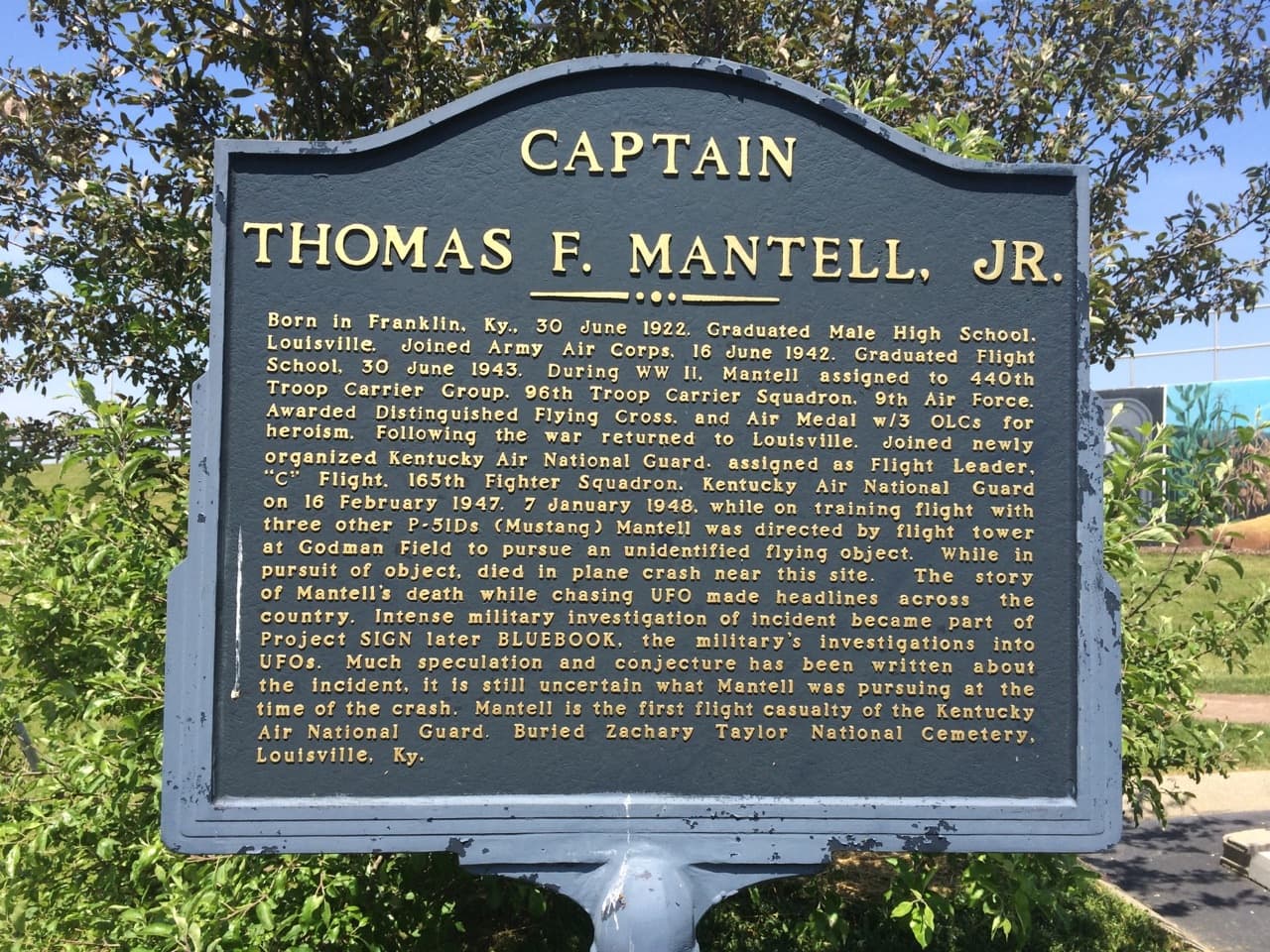
Dayton Journal-Herald (United Press) / FBI / J. Edgar Hoover / USAF Director of Special Investigations (1948). Captain Thomas F. Mantell P-51 Fatality of January 7 1948 (Dayton Journal-Herald Clipping with Last Radio Transmission Verbatim, Wright-Patterson 240+30 Statistics, and Project Sign 'Real Aircraft of Unconventional Design' Language). The UFO Files. https://the-ufo-files-site.netlify.app/dossier/mantell-p51-fatality-january-1948-dayton-clipping
"Captain Thomas F. Mantell P-51 Fatality of January 7 1948 (Dayton Journal-Herald Clipping with Last Radio Transmission Verbatim, Wright-Patterson 240+30 Statistics, and Project Sign 'Real Aircraft of Unconventional Design' Language)." Dayton Journal-Herald (United Press) / FBI / J. Edgar Hoover / USAF Director of Special Investigations. 1948. https://the-ufo-files-site.netlify.app/dossier/mantell-p51-fatality-january-1948-dayton-clipping.
Captain Thomas F. Mantell P-51 Fatality of January 7 1948 (Dayton Journal-Herald Clipping with Last Radio Transmission Verbatim, Wright-Patterson 240+30 Statistics, and Project Sign 'Real Aircraft of Unconventional Design' Language)
Case ID: FBI-62HQ-83894/mantell-p51-fatality-january-1948-dayton-clipping
Agency: Dayton Journal-Herald (United Press) / FBI / J. Edgar Hoover / USAF Director of Special Investigations
Date: 1948-01-07
Source: https://www.war.gov/medialink/ufo/release_1/65_hs1-834228961_62-hq-83894_section_4.pdf
Retrieved: Thu May 07 2026 20:00:00 GMT-0400 (Eastern Daylight Time)
Mirrored on The UFO Files, an archive by Dead Pixel Design. The file is the file. Anything in question is one click from the original.
Summary
Section 4 of FBI 62-HQ-83894 preserves a United Press dispatch from the Dayton Journal-Herald, dated April 27, 1948 (Section 4 page 150, FBI serial 62-83894-169) reporting on Captain Thomas F. Mantell’s January 7, 1948 P-51 fatality over Fort Knox, Kentucky — the canonical pre-Roswell-publication-era pilot fatality directly attributed to a UAP intercept attempt. The clipping preserves Mantell’s last radio transmission verbatim, the Wright-Patterson AFB Project Sign aggregate statistics on 240 domestic + 30 foreign accounts of flying discs investigated, and the “evaluation teams” language that would later become the Project Grudge / Project Blue Book canonical framing on “real aircraft of unconventional design.”
The clipping arrived at FBI HQ in May 1949 via a civilian correspondent — Bailey L. Davis of Atlanta, GA (formerly Hotel Lawrence, Walnut Ridge AR; FBI page 149) — who attached it to a letter to Hoover dated April 29, 1949, alongside (or possibly identical with) a letter from a “Mrs. Frank Gardner” (the cover memo on page 151 attributes the package to Mrs. Frank Gardner). Davis’s letter framed the Mantell case in the era’s standard Communist-paranoia register: he claimed to have submitted “2 types of engines & the flying saucer design” to Eleanor Roosevelt in 1942 via the National Inventors Council, when Henry Wallace was Secretary of Commerce in charge of the Council, and suggested Wallace could have conveyed the designs to Russia. Hoover’s reply on May 10, 1949 (page 151, FBI serial 62-83894-170, declassified 2040 8/21/77 HM) forwarded the package “BY SPECIAL MESSENGER” to the Director of Special Investigations, Department of the Air Force, The Pentagon, Washington 25, D.C.
This is the single in-archive primary-source artifact on Captain Mantell in the entire 62-HQ-83894 case file (grep across all 6 sections returns only Section 4 page 150). The clipping is operationally significant because:
- It preserves Mantell’s last radio transmission verbatim — “I’m closing in to take a good look. It looks metallic and of tremendous size. It’s going up now as fast as I am. That’s 360 miles an hour. I’m going up after it. At 20,000 feet, if I’m no closer, I’ll abandon chase.” This is the source-document quote that would be cited and recited throughout mid-century UAP literature (Ruppelt’s The Report on Unidentified Flying Objects, Keyhoe’s The Flying Saucers Are Real, Project Blue Book closure-era summaries).
- It documents the Wright-Patterson Project Sign aggregate statistics: “240 domestic and 30 foreign accounts of flying discs as having been investigated. Of these, 30 per cent seem to have been weather balloons and the like and 30 per cent more are perhaps explainable conventionally — leaving 40 per cent unexplained.” This 40% baseline-unexplained finding is the Project Sign baseline-statistics dataset that Project Grudge and Project Blue Book would later cite, contest, and refine.
- It records the “evaluation teams” formulation that became canonical: “We can’t prove or disprove the existence of some of the remaining unidentified objects as real aircraft of unconventional design.” This is the Project Sign Estimate-of-the-Situation language pre-General-Twining-pre-General-Vandenberg — the operational framing that the September 23, 1947 Twining memo had introduced and that Project Sign was implementing in early 1948.
- It contains the Air Force’s contemporary public-comment trajectory: “The Air Force recently said there was no evidence that the discs were guided missiles fired from some other country, but that … on the other hand it was not impossible that they were. Later the Air Force announced it was not making any further comments on the discs.” This documents the Project Sign-to-Project Grudge transition narrative in primary press form — the Air Force’s late-1948 stop-public-commenting decision that preceded Project Grudge’s December 1948 reorganization.
Mantell’s death is the foundational pre-Roswell-publication-era pilot fatality case in the popular UAP corpus. The Air Force’s official explanation (eventually settled on as a high-altitude Skyhook balloon misidentification) was reached only in retrospect after multiple years and remained controversial through Captain Edward J. Ruppelt’s Project Blue Book reevaluation. The Bureau preserved the case in primary press form 16 months after Mantell’s death and 4 months before the Project Sign Estimate of the Situation document was rejected by Vandenberg in August 1948, frozen at the moment when Project Sign’s baseline framework was operationally active.
The civilian-correspondent transmission channel is itself a finding: Mantell’s case was sufficiently public-knowledge by April 1949 that civilian correspondents writing to Hoover with UAP theories were attaching the clipping as bona fides for their own claims. Davis’s National-Inventors-Council / Henry-Wallace / Eleanor-Roosevelt narrative places the Mantell case in the Cold-War-era Communist-paranoia framing that recurs throughout the Bureau’s 1948-1950 UAP-correspondence pattern (Pervier, Welton, Walter D. Jones / Toronto cross-loading documented in passes 16, 21, 22).
What the Three Pages Document
Page 149 — The Bailey L. Davis Cover Letter (April 29, 1949)
Letterhead: HOTEL LAWRENCE / Walnut Ridge, Ark. / “AIR COOLED / 75 ROOMS / MODERN / OUR FOOD IS UNEXCELLED” — period-typical Arkansas hotel stationery, with a handwritten “Flying Saucers” annotation top-right.
Verbatim opening:
“Hon. J. Edgar Hoover: / Washington, D.C. / Having read the enclosed clipping you will find with this letter prompts me to send it to you and ask you to check the National Inventors Council files on the 2 types of engines & the flying saucer design that I submitted to Mrs. Eleanor Roosevelt in 1942, while Henry Wallace was Secretary of Commerce who was in charge of the National Inventors Council.”
Davis’s framing:
“I mean just this. See how easy it would have been for Wallace to have conveyed these designs to Russia and withheld them from our own Engineering Dept. You can make the biggest find here of your life, if you look.”
Signed: Bailey L. Davis, 141 Claire Dr. S.E., Atlanta, Ga. Filed RECORDED-104, 62-83894-6, MAY 10 1949.
Page 150 — The Dayton Journal-Herald Clipping (April 27, 1948 — actually April 27 of unspecified year, contextually 1948)
Title block: “New Data, Ideas About Flying Saucers And Death of Pilot Who Chased One” / “By United Press” / “DAYTON, Ohio, April 27.”
The setup:
“The only airman who ever got near a flying saucer crashed and died before he could describe it, the Dayton Journal-Herald said today. The newspaper printed a lengthy dispatch on the mysterious flying discs, based, it said, on hitherto unpublished reports assembled at the Wright-Patterson Air Force base. The Air Force investigation has proved that the flying saucers ‘are not a joke.’ Neither ‘are they a cause for alarm to the population,’ the newspaper said.”
The Fort Knox intercept:
“The closest any airman came to the mystery discs was on Jan. 7, 1948, when one was sighted over Fort Knox, Ky., the dispatch said. Four fighter planes were sent aloft to intercept it, but only Capt. Thomas F. Mantell was able to get close.”
Mantell’s last radio transmission, verbatim:
“‘I’m closing in to take a good look,’ the newspaper quoted him as reporting by radio. ‘It looks metallic and of tremendous size. It’s going up now as fast as I am. That’s 360 miles an hour. I’m going up after it. At 20,000 feet, if I’m no closer, I’ll abandon chase.’”
The fatality:
“Mantell’s plane crashed a few minutes later and he was killed.”
The Wright-Patterson Project Sign aggregate statistics:
“The paper said a report now on file at Wright-Patterson Air Force Base lists 240 domestic and 30 foreign accounts of flying discs as having been investigated. Of these, 30 per cent seem to have been weather balloons and the like and 30 per cent more are perhaps explainable conventionally — leaving 40 per cent unexplained.”
The Air Force’s public-posture trajectory:
“The Air Force recently said there was no evidence that the discs were guided missiles fired from some other country, but that … on the other hand it was not impossible that they were. Later the Air Force announced it was not making any further comments on the discs.”
The “evaluation teams” finding:
“The Dayton paper says the report on which its story is based said the ‘evaluation teams’ stated: ‘We can’t prove or disprove the existence of some of the remaining unidentified objects as real aircraft of unconventional design.’”
Filed FBI serial 62-83894-169 ENCLOSURE.
Page 151 — Hoover’s Forward to USAF Director of Special Investigations (May 10, 1949)
Verbatim:
“May 10, 1949 / CONFIDENTIAL / BY SPECIAL MESSENGER / To: Director of Special Investigations, (I.G.) / Department of the Air Force / The Pentagon / Washington 25, D.C. / From: John Edgar Hoover - Director, Federal Bureau of Investigation / Subject: INFORMATION CONCERNING FLYING SAUCERS / MRS. FRANK GARDNER - INFORMANT”
Body:
“Enclosed is a photostatic copy of a letter dated April 29, 1949, received by this Bureau from Mrs. Frank Gardner concerning flying saucers. The correspondent has been advised that a copy of her letter has been forwarded to the United States Air Force. This letter is being forwarded to you for any action you may deem advisable.”
Filed FBI serial 62-83894-170. Declassified marker: “Declassified 2040 8/21/77 HM” — declassified August 21, 1977 by Bureau action, contemporary with Bruce Maccabee’s NIS FOIA work that surfaced the Kodiak Alaska ONI document (pass 22). 16-named-senior-officials Hoover-era distribution: Tolson, Clegg, Glavin, Ladd, Nichols, Rosen, Tracy, Egan, Gurnea, Harbo, Mohr, Pennington, Quinn Tamm, Tele. Room, Nease, Gandy.
The “Mrs. Frank Gardner” attribution on the cover memo is operationally inconsistent with the page-149 letter signed “Bailey L. Davis.” Possibilities: (a) the Bureau filed two letters in the same package and Hoover’s cover memo references one while the page-149 letter is the other; (b) Davis is Mrs. Frank Gardner’s representative or sister; (c) OCR error in the names. Without a direct page reading the inconsistency cannot be resolved here.
Why This Matters
-
The single in-archive primary-source artifact on Captain Thomas F. Mantell in the entire 62-HQ-83894 case file. Grep across all 6 sections returns only Section 4 page 150. The Mantell case — the canonical pre-Roswell-publication-era pilot fatality directly attributed to a UAP intercept attempt — is preserved in the Bureau record only as a Dayton Journal-Herald United Press dispatch from April 27, 1948, attached to a civilian correspondent’s May 1949 letter to Hoover.
-
The clipping preserves Mantell’s last radio transmission verbatim. “I’m closing in to take a good look. It looks metallic and of tremendous size. It’s going up now as fast as I am. That’s 360 miles an hour. I’m going up after it. At 20,000 feet, if I’m no closer, I’ll abandon chase.” This is the source-document quote that became canonical throughout mid-century UAP literature. The Bureau’s preserved-press-clipping version provides the in-archive verbatim record.
-
The Wright-Patterson Project Sign 240+30 aggregate statistics are documented in the FBI case file at the moment Project Sign was operationally active. “240 domestic and 30 foreign accounts of flying discs as having been investigated… 40 per cent unexplained.” This is the Project Sign baseline-statistics dataset that Project Grudge would inherit (1948-1949) and Project Blue Book would continue (1952-1969). The 40%-unexplained finding is the in-archive operational baseline.
-
The “real aircraft of unconventional design” formulation is preserved in primary press form pre-Project-Grudge. “We can’t prove or disprove the existence of some of the remaining unidentified objects as real aircraft of unconventional design.” This is the Project Sign Estimate-of-the-Situation language pre-General-Twining-pre-General-Vandenberg — Project Sign’s actual analytical-team finding before General Hoyt S. Vandenberg’s August 1948 rejection of the formal Estimate of the Situation document and the resulting reorganization that became Project Grudge in December 1948.
-
The Air Force public-comment-trajectory narrative is in primary press form: “The Air Force recently said there was no evidence that the discs were guided missiles fired from some other country, but that … on the other hand it was not impossible that they were. Later the Air Force announced it was not making any further comments on the discs.” This documents the late-1948 USAF stop-public-commenting decision that preceded Project Grudge’s December 1948 reorganization, in primary press form, frozen at the moment the transition was happening.
-
The Bureau treated the Mantell case as civilian-correspondence-supplied attachment, not as Bureau-internal investigation material. Hoover’s May 10, 1949 cover memo forwards the package to USAF Director of Special Investigations rather than analyzing it internally. The handling is consistent with the Bureau’s standing post-Bureau-Bulletin-#57 (October 1, 1947) defer-to-Air-Force protocol on UAP cases — the Bureau routes the material to USAF without analytical engagement.
-
The civilian-correspondence framing is specific. Bailey L. Davis’s National-Inventors-Council / Henry-Wallace / Eleanor-Roosevelt-as-1942-recipient narrative places the Mantell case in the Cold-War-era Communist-paranoia register that recurs throughout the Bureau’s 1948-1950 UAP-correspondence pattern. By April 1949, civilian correspondents were attaching the Mantell clipping to their own UAP theory letters as bona fides — Mantell’s case had become public knowledge sufficient to function as common-cultural reference within 16 months of his death.
-
The “Special Messenger” + “Confidential” classification on Hoover’s May 10 1949 forward is operationally significant. Hoover sent the package to USAF Pentagon by Special Messenger (hand-delivered, not mail) at Confidential classification. The Bureau’s standing UAP-correspondence handling protocol (form-reply + redirect to AF, per pass-22 civilian-correspondence master page) was upgraded in this case to direct Pentagon hand-delivery — possibly because Davis’s Eleanor-Roosevelt-and-Henry-Wallace claim could have triggered a Domestic Security cross-reference that the Bureau wanted handled with care.
-
August 21, 1977 declassification stamp (“Declassified 2040 8/21/77 HM”) matches the Bruce Maccabee NIS FOIA timing (pass 22) — both 1977 declassifications. The 8/21/77 date is 5 weeks before the 9/20/77 NIS letter declassifying the Kodiak ONI document, suggesting the Bureau’s mid-1977 declassification batch processed both items in the same window.
-
The Mantell case is structurally distinct from every other case in 62-HQ-83894. It is the only in-archive case involving a U.S. military pilot fatality attributed to a UAP intercept attempt. Davidson and Brown (pass 5) died in a B-25 crash returning from Maury Island but their flight was an investigative mission, not an intercept. Mantell’s death was during an active intercept attempt in real time.
Connections
- PURSUE full inventory
- davidson-brown-crash-mission-report
- project-grudge-vital-installations-1948-1949
- belmont-twinkle-master-memo-osi-log-1949-1950
- civilian-correspondence-hoover-pattern-1949-1950
- pre-scully-crashed-saucer-rumor-network-1950
- kodiak-alaska-oni-january-1950
- PURSUE program
- AARO
fbicaptain-mantellproject-sign
Open Questions
- Bailey L. Davis vs. “Mrs. Frank Gardner” attribution discrepancy. Page 149 letter is signed Bailey L. Davis (Atlanta, GA, formerly Walnut Ridge AR Hotel Lawrence). Page 151 cover memo references “Mrs. Frank Gardner” as informant. Without resolving whether these are the same person, two cluster letters, or an OCR error, the correspondent-side framing is uncertain. Cross-archive search target.
- The National Inventors Council 1942 submission — Davis claimed to have submitted “2 types of engines & the flying saucer design” to Eleanor Roosevelt in 1942 via the National Inventors Council, when Henry Wallace was Secretary of Commerce. National Inventors Council records are at the National Archives; cross-archive search target for any 1942 Bailey L. Davis submission.
- The full Dayton Journal-Herald April 27, 1948 article. The clipping at page 150 is partial — right-column fragments are illegible. The full original article in the Dayton Journal-Herald archive would surface additional Mantell case details and the Wright-Patterson Project Sign reporting context.
- The “hitherto unpublished reports assembled at the Wright-Patterson Air Force base” referenced in the article. This is the Project Sign internal-document corpus. Cross-archive search target: Project Sign final reports and Project Sign Estimate of the Situation document, which were Bureau-external in 1948-1949.
- Whether the Bureau received any Mantell-case primary-source material beyond this clipping. Grep across all 6 sections of 62-HQ-83894 returns only page 150 for “Mantell” — confirming the case is preserved only as the civilian-supplied clipping. Mantell-case operational files would live in USAF / Project Sign / Wright-Patterson holdings, not in 62-HQ-83894.
- Whether the August 21, 1977 declassification was Bureau-initiated or FOIA-requested. The “HM” initials on the declassification stamp are the same on both Hoover’s cover memo and (presumably) the Maccabee-Kodiak-FOIA artifact. Bureau records-management archive cross-search target.
- The four fighter planes sent aloft on January 7, 1948. Mantell was one of four; the other three pilots’ names, units, and intercept-attempt details are not preserved in this clipping. Cross-archive search target.
Quotes Worth Keeping
“I’m closing in to take a good look. It looks metallic and of tremendous size. It’s going up now as fast as I am. That’s 360 miles an hour. I’m going up after it. At 20,000 feet, if I’m no closer, I’ll abandon chase.” — Captain Thomas F. Mantell, last radio transmission, January 7, 1948, as reported by United Press / Dayton Journal-Herald and preserved at Section 4 page 150, FBI serial 62-83894-169 ENCLOSURE. The canonical pre-Roswell-publication-era pilot-fatality quote in primary FBI archive form.
“Mantell’s plane crashed a few minutes later and he was killed.” — Dayton Journal-Herald, April 27, 1948, Section 4 page 150. The fatality on the Bureau record.
“The only airman who ever got near a flying saucer crashed and died before he could describe it.” — Dayton Journal-Herald, ibid., Section 4 page 150. The framing the Bureau preserved on the file.
“The Air Force investigation has proved that the flying saucers ‘are not a joke.’ Neither ‘are they a cause for alarm to the population.’” — Dayton Journal-Herald, ibid. The Project Sign analytical-posture summary in primary press form: not a joke, not a cause for alarm. Both halves of the framing preserved on the Bureau record.
“240 domestic and 30 foreign accounts of flying discs as having been investigated. Of these, 30 per cent seem to have been weather balloons and the like and 30 per cent more are perhaps explainable conventionally — leaving 40 per cent unexplained.” — Dayton Journal-Herald, ibid. The Project Sign 240+30 aggregate statistics dataset in primary press form — the baseline that Project Grudge and Project Blue Book would inherit. 40% unexplained as the operational analytic baseline.
“We can’t prove or disprove the existence of some of the remaining unidentified objects as real aircraft of unconventional design.” — “Evaluation teams” finding quoted in the Dayton Journal-Herald, ibid. The Project Sign Estimate-of-the-Situation language pre-General-Vandenberg — Project Sign’s analytical-team finding before Vandenberg’s August 1948 rejection of the formal Estimate of the Situation document. Operationally significant precursor language to Project Grudge’s December 1948 reorganization.
“The Air Force recently said there was no evidence that the discs were guided missiles fired from some other country, but that … on the other hand it was not impossible that they were. Later the Air Force announced it was not making any further comments on the discs.” — Dayton Journal-Herald, ibid., Section 4 page 150. The Air Force’s late-1948 stop-public-commenting decision in primary press form, frozen at the moment the Project-Sign-to-Project-Grudge transition was happening.
“Having read the enclosed clipping you will find with this letter prompts me to send it to you and ask you to check the National Inventors Council files on the 2 types of engines & the flying saucer design that I submitted to Mrs. Eleanor Roosevelt in 1942, while Henry Wallace was Secretary of Commerce who was in charge of the National Inventors Council. … See how easy it would have been for Wallace to have conveyed these designs to Russia and withheld them from our own Engineering Dept.” — Bailey L. Davis to Hoover, April 29, 1949, Section 4 page 149. The civilian-correspondence framing in the Cold-War-era Communist-paranoia register: 1942 Eleanor-Roosevelt-via-Henry-Wallace flying-saucer-design submission alleged to have been concealable by Wallace from U.S. engineering and conveyed to Russia. The Mantell clipping arrived at FBI HQ via this register.
“By Special Messenger / CONFIDENTIAL / This letter is being forwarded to you for any action you may deem advisable.” — J. Edgar Hoover to USAF Director of Special Investigations (Pentagon), May 10, 1949, Section 4 page 151, FBI serial 62-83894-170. The Bureau’s Special-Messenger Pentagon hand-delivery on the Mantell-clipping correspondence — operational upgrade above the standard form-reply + AF-redirect protocol.