PURSUE/pantex-unidentified-object-radar / unknown / PURSUE / DOE
DOE-UAP-D001 — Pantex Unidentified Object Incident: Radar-Tower Image, Sandia-Enhanced (UCNI)
PURSUE / DOE (unkn). DOE-UAP-D001 — Pantex Unidentified Object Incident: Radar-Tower Image, Sandia-Enhanced (UCNI). The UFO Files. https://the-ufo-files-site.netlify.app/dossier/pantex-unidentified-object-radar
"DOE-UAP-D001 — Pantex Unidentified Object Incident: Radar-Tower Image, Sandia-Enhanced (UCNI)." PURSUE / DOE. unkn. https://the-ufo-files-site.netlify.app/dossier/pantex-unidentified-object-radar.
DOE-UAP-D001 — Pantex Unidentified Object Incident: Radar-Tower Image, Sandia-Enhanced (UCNI)
Case ID: PURSUE/pantex-unidentified-object-radar
Agency: PURSUE / DOE
Date: unknown
Source: https://www.war.gov/UFO/?releaseDate=Release+02#records
Mirrored on The UFO Files, an archive by Dead Pixel Design. The file is the file. Anything in question is one click from the original.
Summary
A two-page extract (labeled “Page 5 of 6” and “Page 6 of 6”) from a Pantex Unidentified Object Incident Report, released in PURSUE Release 02 as DOE-UAP-D001. War.gov describes it as “an unidentified object report with enhanced imagery from a Pantex radar tower.” Pantex, near Amarillo, Texas, is the United States’ primary nuclear-weapons assembly and disassembly facility, operated for the DOE/NNSA by Consolidated Nuclear Security, LLC.
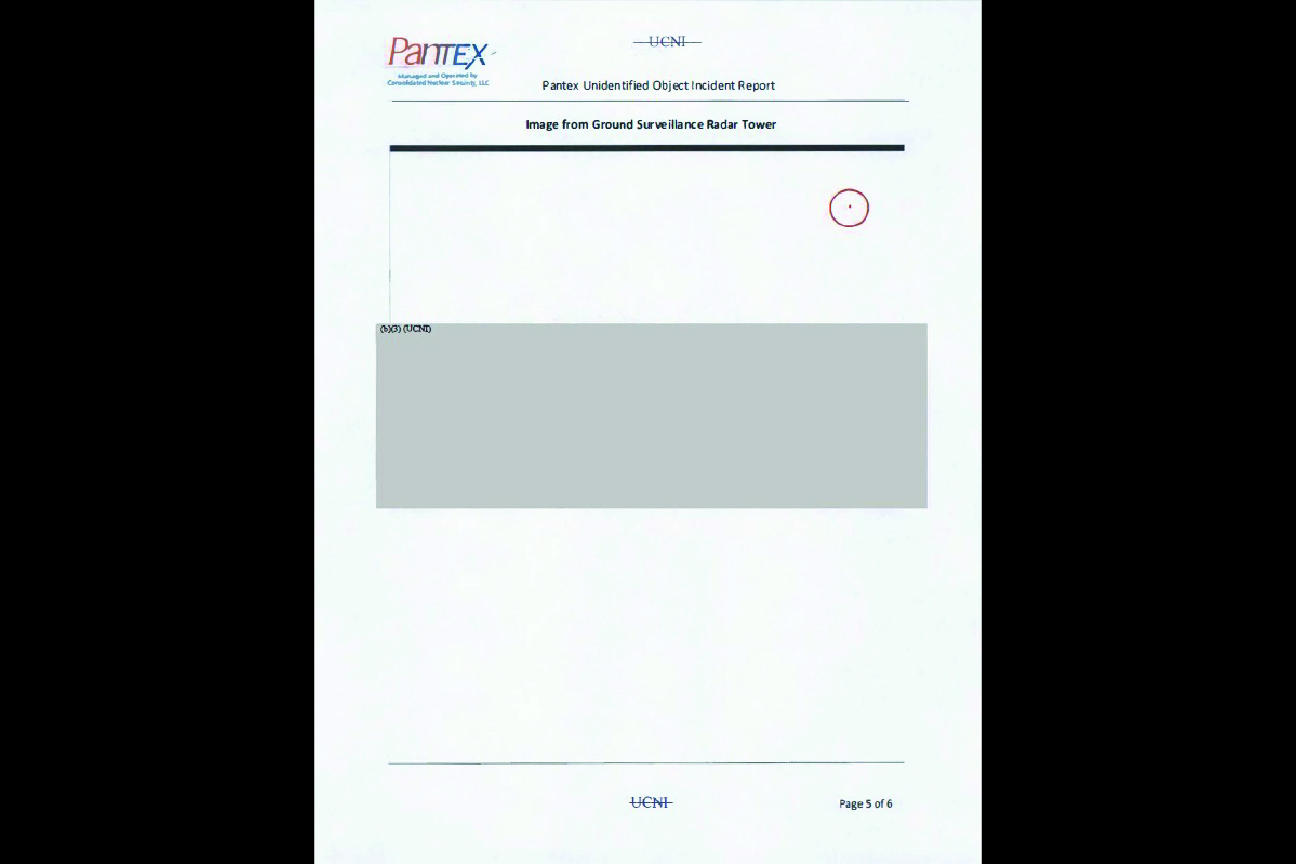
The released pages are image pages, not text: a captured frame from a Ground Surveillance Radar Tower, and a set of “Sandia National Labs Enhanced Images of the Object.” The pages are marked UCNI (Unclassified Controlled Nuclear Information) and carry a (b)(3) statutory exemption notation. The actual analytical narrative (pages 1-4 of the 6-page report) is not in this extract.
What the Released Pages Contain
- Page 5 of 6: “Image from Ground Surveillance Radar Tower,” under the Pantex / Consolidated Nuclear Security banner, marked UCNI, with a (b)(3) (UCNI) redaction notation.
- Page 6 of 6: “Sandia National Labs Enhanced Images of the Object,” again marked UCNI.
Because these are scanned images, the OCR transcript captures only the page furniture (titles, banners, page numbers, control markings). The substance is the imagery itself, which must be viewed in the PDF.
Why This Document Matters
- Nuclear-facility nexus, again. A documented unidentified-object incident at the nation’s nuclear-weapons assembly plant fits the dominant pattern of both PURSUE releases and of the Sandia green fireball file in this same tranche. Pantex and Sandia are institutionally linked, and Sandia National Labs performed the image enhancement here.
- Instrumented detection. Unlike eyewitness narratives, this incident produced a ground-surveillance-radar image of the object that was significant enough for Sandia National Labs to enhance — a real sensor artifact, not a recollection.
- Controlled-information handling. The UCNI marking and (b)(3) exemption indicate the incident was handled inside the nuclear-security control regime, not as an open public-affairs item. That an incident report like this was declassified at all for PURSUE is itself notable.
Caveats
- This is a partial extract — two image pages out of a six-page report. The incident date, location specifics, witness/sensor details, and any official assessment are on pages not included here.
- The object’s nature, size, and behavior cannot be determined from the released material. War.gov’s phrasing (“unidentified object”) is the only official characterization in hand.
- The released pages contain essentially no machine-readable text; any analysis must rest on viewing the imagery in the PDF, not on the OCR transcript.
Provenance
- Document ID: DOE-UAP-D001 (PDF title: “DOE-UAP-D001 PANTEX”)
- Official source: U.S. Department of War (DOE record), PURSUE Release 02, cleared for release May 22, 2026. Release 02 records.
- Release announcement: DOW press release, May 22, 2026.
- Document bundle (official): release_02_document_bundle.zip (70.1 MB).
- Preview image (official): DOE-UAP-D001 slideshow image.
- Control markings: UCNI; (b)(3).
- Local OCR transcript:
raw/pursue-release-02-ocr/DOE-UAP-D001.txt.
Connections
- Sandia green fireballs (DOW-UAP-D017) — Sandia link, nuclear-installation pattern
- PURSUE program
- AARO
- Release 02 full inventory
- Release 02 master report
Open Questions
- When and where exactly did the Pantex incident occur, and what do pages 1-4 of the report say?
- What did the ground-surveillance radar actually capture, and what did Sandia’s enhancement reveal?
- Was the object ever resolved, and why was the report routed through UCNI controls rather than a standard incident channel?