FBI-62HQ-83894/project-grudge-vital-installations-1948-1949 / 1949-01-31 / FBI
The Project Grudge Cluster: Vital Installations, Lincoln La Paz Green Fireballs, Camp Hood–Killeen Base Sightings, the Walter Winchell Affair, and the May 1949 USAF Recovery Denial (December 1948 – May 1949)
Between January 31 and May 26, 1949, the SAC San Antonio Field Office and FBI Headquarters generated a tightly-related document cluster on the new "Vital Installations" caption that effectively reconstructs the early Project Grudge era from the Bureau side.
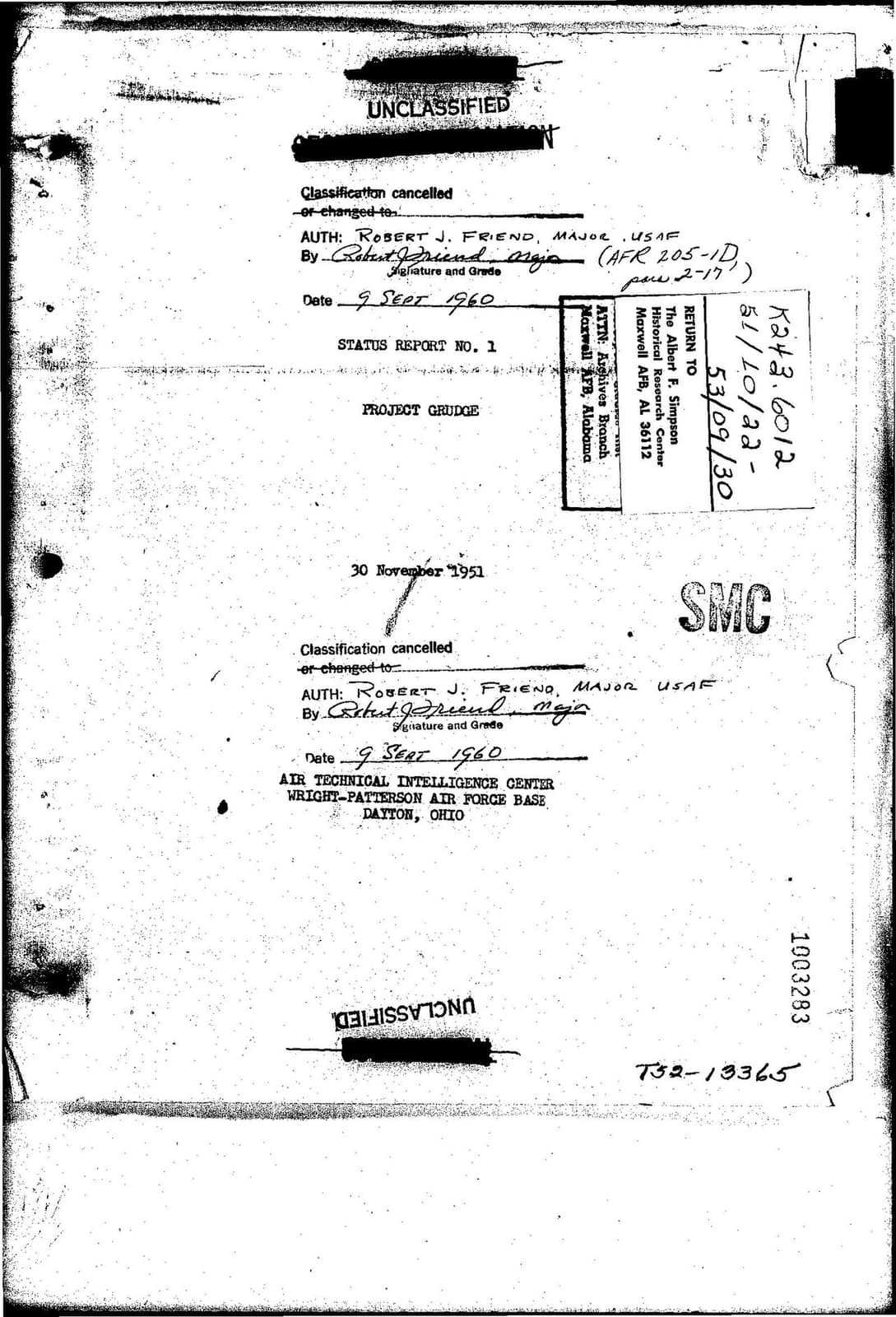
FBI / U.S. Department of Justice (1949). The Project Grudge Cluster: Vital Installations, Lincoln La Paz Green Fireballs, Camp Hood–Killeen Base Sightings, the Walter Winchell Affair, and the May 1949 USAF Recovery Denial (December 1948 – May 1949). The UFO Files. https://the-ufo-files-site.netlify.app/dossier/project-grudge-vital-installations-1948-1949
"The Project Grudge Cluster: Vital Installations, Lincoln La Paz Green Fireballs, Camp Hood–Killeen Base Sightings, the Walter Winchell Affair, and the May 1949 USAF Recovery Denial (December 1948 – May 1949)." FBI / U.S. Department of Justice. 1949. https://the-ufo-files-site.netlify.app/dossier/project-grudge-vital-installations-1948-1949.
The Project Grudge Cluster: Vital Installations, Lincoln La Paz Green Fireballs, Camp Hood–Killeen Base Sightings, the Walter Winchell Affair, and the May 1949 USAF Recovery Denial (December 1948 – May 1949)
Case ID: FBI-62HQ-83894/project-grudge-vital-installations-1948-1949
Agency: FBI / U.S. Department of Justice
Date: 1949-01-31
Source: https://www.war.gov/medialink/ufo/release_1/65_hs1-834228961_62-hq-83894_section_4.pdf
Retrieved: Thu May 07 2026 20:00:00 GMT-0400 (Eastern Daylight Time)
Mirrored on The UFO Files, an archive by Dead Pixel Design. The file is the file. Anything in question is one click from the original.
Summary
Between January 31 and May 26, 1949, the SAC San Antonio Field Office and FBI Headquarters generated a tightly-related document cluster on the new “Vital Installations” caption that effectively reconstructs the early Project Grudge era from the Bureau side. This is the parallel arc to the Oak Ridge / Gasser case (see oak-ridge-gasser-atomic-propulsion-1947-1949) — different SAC office, different FBI serial range, different operational consequence, but the same ~75-day window in early 1949 when the FBI was forced to re-engage the flying-disc problem after eighteen months of withdrawal under Bureau Bulletin #57.
The cluster contains:
- The first FBI primary-source reference to “Project Grudge” by name. SAC San Antonio’s March 22, 1949 letter to Director (FBI serial 62-83894-161) records: “G-2, 4th Army, has now advised that the above matter is now termed ‘Unconventional Aircraft’ and investigations concerning such matters have been given the name ‘Project Grudge’.” The Air Materiel Command T-2 office took primary responsibility for Green Fireball investigations on or before February 16, 1949.
- Dr. Lincoln La Paz’s “Starvation Peak incident” characterization — six specific observational characteristics ruling out a normal meteorite fall, in primary form. Cited as the methodological reason the Green Fireball phenomena could not be classified as ordinary fireball events. La Paz was the University of New Mexico meteoriticist running the AAF/AMC investigation through 1949.
- The Camp Hood / Killeen Base sightings (March 6, 7, 17, 31, 1949). Multiple independent observations adjacent to the Killeen Base atomic-weapons storage installation by 12th Armored Infantry Battalion alert-force personnel. The March 31, 1949 sighting by 1st Lt. Frederick W. Davis includes documented telephone-line static when he attempted to call HQ immediately after.
- The Walter Winchell affair. Three separate Winchell-to-Hoover envelopes routed through the FBI between April 20 and May 23, 1949, each with a Winchell handwritten note (“True?”, “Ha!”). The Bureau formally declined to interview Winchell about his April 3, 1949 “flying discs definitely emanated from Russia” broadcast despite a G-2 Fourth Army request that they do so.
- The May 26, 1949 USAF flying-saucer recovery denial. V. P. Keay’s memo to Fletcher (FBI serial 62-83894-172) records OSI-USAF Col. William E. Carpenter’s specific assertion — sourced through individuals he trusted to bypass “the usual channels from which he possibly would receive a stock answer” — that “there is no information available in any arm of the Air Force to the effect that any flying saucers of any kind have been recovered in the United States.” Dated approximately two years to the day after Roswell.
- A direct contradiction of the Gasser Soviet thesis from pass 8. SAC San Antonio’s March 22, 1949 letter (page 121) records the working military-intelligence theory at the moment Project Grudge was forming: “There appears to be reason to believe that the above-mentioned phenomena may be connected with secret experiments being conducted by some U.S. Government Agency as it is believed that the United States is farther advanced in guided missile development than any foreign power.” Same week the FBI is being told by Gasser that the flying-disc phenomenon is Russian, the Fourth Army is telling them it’s American.
- A Frisbee-history footnote. A May 15, 1949 letter from Warren R. Franscioni (San Luis Obispo, California) — co-inventor of the Frisbee with Fred Morrison — to Walter Winchell pitching his “FLYIN’ SAUCER” toy in language that explicitly leveraged Winchell’s flying-disc broadcasts. Winchell forwarded it to Hoover with the handwritten annotation “Ha!”
What the Vital Installations Documents Document
The January 31, 1949 SAC San Antonio memo (Section 4 pages 115, 117)
SAC San Antonio’s first letter to Director under the new “PROTECTION OF VITAL INSTALLATIONS” caption (Bureau File 65-58300, FBI serial 62-83894-159):
“At recent Weekly Intelligence Conferences of G-2, ONI, OSI, and F.B.I., in the Fourth Army Area, Officers of G-2, Fourth Army have discussed the matter of ‘Unidentified Aircraft’ or ‘Unidentified Aerial Phenomena’ otherwise known as ‘Flying Discs’, ‘Flying Saucers’, and ‘Balls of Fire’. This matter is considered top secret by Intelligence Officers of both the Army and the Air Forces.” — SAC San Antonio to Director, January 31, 1949 (Section 4 page 115)
The memo establishes the foreign-origin precedent: “The first such sightings were reported from Sweden, and it was thought that the objects, the nature of which was unknown, might have originated in Russia.” This is a reference to the 1946 “ghost rockets” phenomenon over Scandinavia.
The Eastern Airlines case is logged in unusual detail:
“In July 1948 an unidentified aircraft was ‘seen’ by an Eastern Airlines Pilot and Co-Pilot and one or more passengers of the Eastern Airlines Plane over Montgomery, Alabama. This aircraft was reported to be of an unconventional type without wings and resembled generally a ‘rocket ship’ of the type depicted in comic strips. It was reported to have had windows; to have been larger than the Eastern Airlines plane, and to have been traveling at an estimated speed of 2700 miles an hour. It appeared out of a thunderhead ahead of the Eastern Airlines plane and immediately disappeared in another cloud narrowly missing a collision with the Eastern Airlines plane. No sound or air disturbance was noted in connection with this appearance.” — SAC San Antonio to Director, January 31, 1949 (Section 4 page 115)
This is the Chiles-Whitted case in primary FBI form — a load-bearing 1948 sighting frequently cited in UAP historical literature. The detail “wings… rocket ship… windows… larger than the Eastern Airlines plane… 2700 miles an hour” matches the historical record.
The memo continues with the Los Alamos cluster: Special Agents of OSI, airline pilots, military pilots, Los Alamos Security Inspectors, and private citizens reporting unexplained phenomena on December 5, 6, 7, 8, 11, 13, 14, 20, 28, 1948 and January 6, 1949. Dr. Lincoln La Paz “a Meteorologist of some note” was “in charge of the observations near Los Alamos, attempting to learn characteristics of the unexplained phenomena. Up to this time little concrete information has been obtained.”
The continuation page (Section 4 page 117) records the Mrs. Madeline Gwynne Merchant theory:
“She has written many letters to Military Authorities concerning her theories regarding Atomic Energy. She has generally been considered unreliable and possibly mentally unbalanced. She, however, has submitted to Military authorities the only theory thus far known that has any credibility at all, namely, that the lights are manifestations of cosmic rays which are directed toward a specific point. She further theorizes that such rays may interfere with the ignition of motors and may account for various unexplained air crashes.” — SAC San Antonio to Director, January 31, 1949 (Section 4 page 117)
Page 117 also names the protected installations: “the Fourth Army has the responsibility of protecting vital installations at Los Alamos, New Mexico, Sandia Base, New Mexico, and Camp Hood, Texas.” The Bureau’s own posture: “G-2 and O.S.I. are actively engaged in investigating this matter. No investigation is being conducted by this office.”
The March 22, 1949 SAC San Antonio follow-up (Section 4 pages 120, 121)
Two months later. The follow-up letter (FBI serial 62-83894-161) names Project Grudge in primary form:
“G-2, 4th Army, has now advised that the above matter is now termed ‘Unconventional Aircraft’ and investigations concerning such matters have been given the name ‘Project Grudge’.” — SAC San Antonio to Director, March 22, 1949 (Section 4 page 120)
Project Grudge succeeded Project SIGN at Wright-Patterson AFB and ran through late 1949. This is the earliest in-Bureau primary-source mention of the Grudge name in the 62-HQ-83894 mining done so far. The same paragraph documents the responsibility transfer:
“G-2, 4th Army, advised on February 16, 1949, a conference was held at Los Alamos, New Mexico, to consider the so-called ‘Green fire ball phenomena’ which began about December 5, 1948. It was brought out this question has been classified ‘secret’ and that investigation is now the primary responsibility of the U.S. Air Force, Air Materiel Command, T-2.” — SAC San Antonio to Director, March 22, 1949 (Section 4 page 120)
The Lincoln La Paz “Starvation Peak incident” characterization is the only formal scientific finding in the entire Vital Installations cluster:
“Dr. LINCOLN LA PAZ of the University of New Mexico, discussed one siting which he himself had made which was termed the ‘Starvation peak incident’ and described the following characteristics which indicated that the phenomenon could not be classified as a normal meteorite fall.
- There was an initial bright light (no period of intensity increase) and constant intensity during the duration of the phenomenon.
- Yellow green color about 5200 Angstroms.
- Essentially horizontal path.
- Trajectory traversed at constant angular velocity.
- Duration about two seconds.
- No accompanying noise.” — SAC San Antonio to Director, March 22, 1949 (Section 4 page 120)
This is the founding methodological document of the Green Fireball investigation in FBI primary source. La Paz was the country’s leading meteoriticist; the six-point characterization is what made the Green Fireballs stop being classifiable as ordinary fireballs and start being classifiable as anomalous.
The continuation page (Section 4 page 121) records the operational consequence:
“It was brought out that since December 5, 1948 there have been more than ten incidents analagous to the ‘green fireball’ above described and some twenty others with minor deviations from the above. It is also pointed out that the only sitings which had occurred seemed to have been confined to the Los Alamos, Las Vegas, and West Texas triangle.
G-2 also advised that as of November 1, 1948, information had been received from higher Military authorities that the Air Force had advised that such sitings occur periodically and that another period of sitings was then imminent. Further, on February 14, 1949, higher Military authorities advised that it was believed that ultimately it would be found that the phenomena in question have a natural explanation.” — SAC San Antonio to Director, March 22, 1949 (Section 4 page 121)
The November 1, 1948 advisory is striking. The Air Force had foreknowledge — “such sitings occur periodically and that another period of sitings was then imminent” — issued more than a month before the December 5, 1948 wave began. Whether this was prediction from prior pattern or operational knowledge of secret experiments is precisely the open question the document then addresses:
“There appears to be reason to believe that the above-mentioned phenomena may be connected with secret experiments being conducted by some U.S. Government Agency as it is believed that the United States is farther advanced in guided missile development than any foreign power.” — SAC San Antonio to Director, March 22, 1949 (Section 4 page 121)
This is the operational counterthesis to Gasser’s January 1949 Russian-attribution theory. Same Bureau, same week. Knoxville says Soviet. San Antonio says American. The Bureau-internal record contains both, simultaneously, with no resolution attempted.
The first Camp Hood sightings appear in this same letter:
“It is further noted that about 7:30 p.m., March 6, 1949, what was at first thought to be a flare was seen approximately one-half mile north of Killeen Base in the area of the Vital Installation at Camp Hood, Texas, and a second flare was noticed at 1:45 a.m., March 7, 1949, approximately three miles from Killeen Base. It has since been concluded that the flares seen near Killeen are probably similar to the phenomena previously noted in the Los Alamos, Sandia Base Area although these are the first sitings of such phenomena near Camp Hood.” — SAC San Antonio to Director, March 22, 1949 (Section 4 page 121)
Killeen Base is the underground atomic-weapons storage installation at Camp Hood (later renamed Killeen Base / West Fort Hood Atomic Weapons Storage Annex). The phenomena’s appearance there extends the Los Alamos / Sandia / West Texas pattern to a fourth nuclear-weapons site.
The April 4, 1949 SAC San Antonio third memo and the Winchell trigger (Section 4 pages 145, 147)
Two weeks later, after the March 31 Lt. Davis sighting, SAC San Antonio writes again (FBI serial 62-83894-168):
“The Office of the Assistant Chief of Staff, G-2, 4th Army, has advised that at 11:50 P.M. March 31, 1949 a lighted object about the size of a basketball, reddish white in color, followed by a fire trail, was observed southwest of Killeen Base, adjacent to Camp Hood, Texas. The observation was made by 1st Lt. FREDERICK W. DAVIS, who was in charge of a platoon, Company C, 12th Armored Infantry Battalion, which is assigned as a part of an alert force (called force Abel) from Camp Hood, whose function is to protect the installation at Killeen Base.” — SAC San Antonio to Director, April 4, 1949 (Section 4 page 145)
The technical detail: the object was at 6,000 ft, traveling parallel to the ground, passed directly over Davis at “rapid rate of speed,” in view 10–15 seconds, then “suddenly disappeared high in the sky without having descended.” No sound or odor. Clear night.
“When Lt. DAVIS attempted to advise his headquarters by telephone immediately after the sighting, he heard static or electrical interference on the telephone line which he stated might be possible radio interference.” — SAC San Antonio to Director, April 4, 1949 (Section 4 page 145)
This is documented telephone-line interference following a UAP overflight at a nuclear-weapons-protection alert force position, in primary FBI source. It is the kind of detail that gets quoted out of UAP literature for decades; the underlying document is now in primary form.
Page 145 also introduces the Walter Winchell trigger:
“It is noted that Mr. WALTER WINCHELL, on his Sunday evening broadcast, April 3, 1949, stated that ‘flying discs’ seen in this country definitely emanated from Russia.
On April 4, 1949, G-2, 4th Army, contacted this office, inquiring as to whether we had any information that would substantiate or discredit the statements made by WALTER WINCHELL.” — SAC San Antonio to Director, April 4, 1949 (Section 4 page 145)
The continuation (Section 4 page 147):
“In view of the interest and concern of 4th Army military authorities who have the duty of protecting the vital installations at Los Alamos, N. M., Sandia Base, N. M. in the El Paso Division, and the Camp Hood area in the San Antonio Division, it is suggested that the Bureau may desire to arrange to have Mr. WINCHELL interviewed concerning the source of his information that ‘flying discs’ emanate from Russia.” — SAC San Antonio to Director, April 4, 1949 (Section 4 page 147)
The Bureau’s April 26 reply: no Winchell interview (Section 4 page 143)
Director’s reply to SAC San Antonio (FBI serial 62-83894-168 reply, dated April 26, 1949):
“In regard to your request for information that would substantiate or discredit the statements made by Walter Winchell on his broadcast of April 3, 1949, your attention is directed to SAC Letter No. 38 dated March 25, 1949, captioned ‘Flying Disks.’
For your strictly confidential information, the data contained in SAC Letter No. 38 was obtained in confidence from a colonel in the United States Air Materiel Command, who obtained his information from persons actively engaged in the investigation of this subject.
No interview with Walter Winchell will be made by the Bureau concerning the source of his statements referred to in your referenced letter.” — Director to SAC San Antonio, April 26, 1949 (Section 4 page 143)
The reply is operationally important for two reasons:
- It identifies the source of SAC Letter No. 38 (the March 25, 1949 field-letter on flying disks) as “a colonel in the United States Air Materiel Command.” That is Col. C. D. Gasser — the same NEPA Project resident engineer documented in pass 8. The Bureau’s confidential field guidance on flying-disc collection was sourced from one off-the-record AMC engineer’s interview.
- The Bureau formally declined to interview Walter Winchell. Winchell was personally well-connected to Hoover — the routing list on the relayed-Winchell-attachments cover sheets shows direct Director-of-FBI handling. The decision not to interview him is a deliberate political call, not a procedural default.
The same letter formalizes the standing FBI category: “You are instructed in the future to report information relating to flying disks under the above caption [Protection of Vital Installations].” This becomes the durable Bureau classification.
The Walter Winchell affair documents (Section 4 pages 137, 141, 165, 171, 173)
Three separate Winchell→Hoover envelopes pass through the file in April–May 1949, each a different Winchell handwritten note:
April 20, 1949 (Section 4 page 137 cover): “The attached was sent to the Director by Walter Winchell.” Tolson, Clegg, Glavin, Ladd, Nichols all checkmarked. Attachment is the C.A. Atkins / Griffith Park letter.
April 25, 1949 (Section 4 page 165 cover): “The attached was forwarded to the Director by Walter Winchell. The notation thereon reads: ‘To J. Edgar Hoover. True?’” Attachment is Robert Ripley’s Western Union telegram about a “Japanese flying saucer.” (Routing list checkmarks: Tolson, Glavin, Ladd, Nichols.)
May 23, 1949 (Section 4 page 171 cover): “The attached was sent to the Director by Walter Winchell. The handwritten notation thereon reads: ‘To Hoover! Ha!’” Attachment is the Franscioni FLYIN’ SAUCER toy letter (page 173). Routing checkmarks: Tolson, Nichols. Marginalia: “For Info - No Action necessary.”
The Atkins / Griffith Park letter (April 10, 1949 Hollywood, CA, Section 4 page 141) is from C. A. Atkins (4312 Los Feliz, Hollywood) writing to Winchell to support Winchell’s Russian-origin thesis. It describes a Friday April 1949 sighting in Griffith Park by three Department of Recreation and Parks employees (DeJarnett + two co-workers) — “It was a Disc… I am inclined to call a person a liar that says there are no disc’s.” Marginalia on the FBI copy: “Air Force / 5-3-49” — i.e., the Bureau routed it onward to the Air Force on May 3.
The Ripley telegram is referenced in the May 26 V. P. Keay memo (Section 4 page 160) and is the trigger for the FBI’s most important flying-saucer-recovery document in this cluster.
The Franscioni letter (Section 4 page 173) is one of the more delightful pieces of cultural history in the entire 62-HQ-83894 file:
“Under attached cover you will find a sample of our item. Should you do no more than take our FLYIN’ SAUCER out, carefully read the instructions, and fly it; I will have accomplished a portion of my expectations.
For the past few weeks I have listened with more than an indifferent attitude, to your various Sunday evening broadcasts and comments concerning Flying Saucers… Your comment this evening, concerning the Gyroscopic Theories, sparkplugged my actions.
Along with the phases of merchandising mentioned in the attached articles, I should like to mention that one troop of Boy Scouts in Los Angeles are purchasing and enthusiastically include them as a major portion of their recreation program.” — Warren R. Franscioni, San Luis Obispo CA, May 15, 1949 (Section 4 page 173)
Warren R. Franscioni co-invented the Frisbee with Fred Morrison in 1948 — they marketed the original disc as the “Flyin-Saucer” before Wham-O picked it up and renamed it the Pluto Platter and then the Frisbee. This is the inventor of the Frisbee, in primary FBI source, using Walter Winchell’s flying-saucer broadcasts as a marketing channel less than a year after the toy’s invention. Hoover’s office filed it. Winchell’s “Ha!” annotation is the only commentary.
The May 26, 1949 Keay→Fletcher memo: the USAF recovery denial (Section 4 page 160)
The most evidentially load-bearing single document in the cluster (FBI serial 62-83894-172):
BACKGROUND: Walter Winchell forwarded to the Director a Western Union telegram he had received from Robert Ripley which stated that he, Ripley, had the only authentic Japanese flying saucer ever recovered in this country. Mr. Winchell noted on the telegram, “To J. Edgar Hoover - True?”
DETAILS: This matter was discussed by Special Agent Reynolds with the Intelligence Division of the Army, who advised that they had no information concerning any Japanese flying saucer ever having been recovered in the United States.
This matter was discussed with Colonel William E. Carpenter, OSI-USAF, who advised on April 27, 1949 that he had interested himself in the flying saucers and related subjects and that in so far as could be determined by him through his sources in the Air Force, which are excellent, there is no authentic information available concerning the phenomenon of the flying saucers. He advised he would check with the authorities at Wright Field to determine if any information is available concerning the recovery of a Japanese flying saucer.
Colonel Carpenter has now advised that there is no information available in any arm of the Air Force to the effect that any flying saucers of any kind have been recovered in the United States. Colonel Carpenter stated delay had been encountered in determining this fact inasmuch as inquiries had been directed through individuals known to him and trusted by him and not through the usual channels from which he possibly would receive a stock answer. — V. P. Keay to Mr. Fletcher, May 26, 1949 (Section 4 page 160)
This is documentary FBI primary source on a flying-saucer-recovery question, dated within two years of Roswell, sourced through OSI-USAF Col. William E. Carpenter who deliberately routed his inquiries around stock-answer channels. The Carpenter denial is broader than the Ripley question — it covers any flying saucers of any kind recovered in the United States.
The “delay had been encountered” wording is itself notable: Carpenter’s first response on April 27, 1949 was that he would check Wright Field. The follow-up answer arrives a month later. The month-long delay is consistent with someone genuinely working back-channels, not someone returning a quick desk-confirmation.
Why This Matters
- Project Grudge appears in primary FBI source by name. SAC San Antonio’s March 22, 1949 letter (FBI serial 62-83894-161) is now the earliest Bureau-internal in-archive reference to the Grudge name. Previously historians worked from later Air Force record fragments.
- The Lincoln La Paz Starvation Peak six-point characterization is preserved in primary FBI source. The methodological case for treating the Green Fireballs as anomalous (vs. ordinary meteorite falls) is now sourced and quotable.
- The Camp Hood / Killeen Base cluster extends the nuclear-installation pattern. Los Alamos, Sandia, Killeen — three of the four atomic-weapons-relevant Vital Installations are in the same cluster’s primary reports. The fourth Army installation in scope (Camp Hood proper) saw its first sightings on the cluster’s clock.
- Documented telephone-line interference following a UAP overflight at a nuclear-weapons alert force position (Lt. Frederick W. Davis, March 31, 1949, Killeen Base). Cited in UAP literature for decades — the underlying primary FBI source is now public.
- The Bureau-internal record contains both the Soviet thesis (Gasser, Section 4 page 87) and the American-secret-experiment thesis (SAC San Antonio, Section 4 page 121) simultaneously, in the same 75-day window, with no resolution. This is not an analytical gap — it is the documented epistemic state of FBI flying-disc thinking in March 1949.
- Walter Winchell was a personally-routed Director-of-FBI matter. Three separate Winchell→Hoover envelopes pass through the file in April–May 1949 with direct senior-Bureau routing. The Bureau formally declined to interview him on G-2 Fourth Army’s request. This is a political-relationship document layered into a flying-disc investigation.
- OSI-USAF Col. William E. Carpenter’s May 1949 denial of any flying-saucer recovery in the United States is the cleanest in-document “we don’t have any saucers” assertion in 62-HQ-83894 read so far. The methodological caveat — sources bypassing stock-answer channels, month-long back-channel verification — gives the denial unusual weight as a primary source.
- The Frisbee inventor is in the file. Warren R. Franscioni’s May 1949 letter to Winchell pitching the Flyin-Saucer toy is documentary primary-source evidence of how the flying-disc-publicity moment seeded the early commercial disc-toy industry, less than a year after the toy’s invention. A small but charming cultural-history artifact.
Connections
- PURSUE full inventory
- PURSUE master report (master synthesis)
- oak-ridge-gasser-atomic-propulsion-1947-1949 (the parallel arc, same time window)
- rhodes-phoenix-photographs-1947
- maury-island-1947
- muroc-1947-cic-affidavits
- 1947-california-montana-cic
- davidson-brown-crash-mission-report
- philadelphia-1950-soap-suds-disc
- UAP disclosure (concept)
Open Questions
- SAC Letter No. 38 (March 25, 1949) — the field-letter referenced in the Director’s April 26 reply. Its full text, particularly the “type of questions to be asked of persons who voluntarily submit information,” would be the operational guidance the FBI was using to collect from civilian witnesses in mid-1949. Not yet located in the OCR’d Sections.
- The February 16, 1949 Los Alamos Project Grudge conference referenced in SAC San Antonio’s March 22 letter. AMC T-2’s notes on that conference would be the bridging document between Project SIGN and Project Grudge formally.
- Dr. Lincoln La Paz’s full Starvation Peak written report. The six-point summary is reproduced; the underlying detailed report is presumably at the AMC T-2 / Wright-Patterson archive.
- The Eastern Airlines / Chiles-Whitted case primary documents. SAC San Antonio’s January 1949 summary references it but the primary Bureau record on the July 1948 Montgomery AL incident — which precedes this cluster — should be in Section 3 or earlier portions of Section 4.
- The Robert Ripley “Japanese flying saucer” telegram itself. Referenced in the May 26 Keay memo (Section 4 page 160) and in the April 25 cover sheet (Section 4 page 165). The Ripley telegram text is not reproduced in the OCR’d portions read.
- The Bureau’s April 27, 1949 conversation with OSI-USAF Col. William E. Carpenter. The May 26 memo records his initial response; the full conversation log presumably exists in a paired Bureau-internal memo not yet located.
- Mrs. Madeline Gwynne Merchant’s August 10, 1948 Atlanta Bureau letter referenced in the January 31, 1949 SAC San Antonio memo (Section 4 page 117). Cosmic-ray-and-ignition-failure theory is unusual enough to be worth chasing if her letter survives.
- Winchell’s own intelligence sources. The Bureau formally declined to interview Winchell about his “flying discs definitely emanated from Russia” claim. Whether his source was Gasser-equivalent (off-the-record military engineer) or a public-domain extrapolation is unanswered.
Quotes Worth Keeping
“G-2, 4th Army, has now advised that the above matter is now termed ‘Unconventional Aircraft’ and investigations concerning such matters have been given the name ‘Project Grudge’.” — SAC San Antonio to Director, March 22, 1949 (Section 4 page 120, FBI serial 62-83894-161). The earliest in-Bureau primary-source mention of Project Grudge by name in the 62-HQ-83894 mining done so far.
“1. There was an initial bright light (no period of intensity increase) and constant intensity during the duration of the phenomenon. 2. Yellow green color about 5200 Angstroms. 3. Essentially horizontal path. 4. Trajectory traversed at constant angular velocity. 5. Duration about two seconds. 6. No accompanying noise.” — Dr. Lincoln La Paz “Starvation peak incident” characterization, transmitted by SAC San Antonio to Director, March 22, 1949 (Section 4 page 120). The methodological reason the Green Fireballs were not classifiable as ordinary meteorite falls.
“There appears to be reason to believe that the above-mentioned phenomena may be connected with secret experiments being conducted by some U.S. Government Agency as it is believed that the United States is farther advanced in guided missile development than any foreign power.” — SAC San Antonio to Director, March 22, 1949 (Section 4 page 121). The American-secret-experiment counterthesis to Gasser’s Russian-attribution theory, in primary FBI source, contemporaneous to Gasser’s briefing.
“G-2 also advised that as of November 1, 1948, information had been received from higher Military authorities that the Air Force had advised that such sitings occur periodically and that another period of sitings was then imminent.” — SAC San Antonio to Director, March 22, 1949 (Section 4 page 121). Air Force foreknowledge of the December 1948 Green Fireball wave, issued more than a month before the wave began.
“When Lt. DAVIS attempted to advise his headquarters by telephone immediately after the sighting, he heard static or electrical interference on the telephone line which he stated might be possible radio interference.” — SAC San Antonio to Director, April 4, 1949 (Section 4 page 145). Documented telephone-line interference following a UAP overflight at a nuclear-weapons-protection alert force position, in primary FBI source.
“For your strictly confidential information, the data contained in SAC Letter No. 38 was obtained in confidence from a colonel in the United States Air Materiel Command, who obtained his information from persons actively engaged in the investigation of this subject. No interview with Walter Winchell will be made by the Bureau concerning the source of his statements referred to in your referenced letter.” — Director to SAC San Antonio, April 26, 1949 (Section 4 page 143). The Bureau’s named-source attribution of its flying-disc field guidance to Col. C. D. Gasser, plus the formal decision to leave Walter Winchell unquestioned despite a G-2 Fourth Army request.
“Colonel Carpenter has now advised that there is no information available in any arm of the Air Force to the effect that any flying saucers of any kind have been recovered in the United States. Colonel Carpenter stated delay had been encountered in determining this fact inasmuch as inquiries had been directed through individuals known to him and trusted by him and not through the usual channels from which he possibly would receive a stock answer.” — V. P. Keay to Mr. Fletcher, May 26, 1949 (Section 4 page 160, FBI serial 62-83894-172). The cleanest in-document “we don’t have any saucers” assertion in 62-HQ-83894 read so far, sourced through deliberate stock-answer-bypassing back-channels two years to the day after Roswell.
“Your comment this evening, concerning the Gyroscopic Theories, sparkplugged my actions… I should like to mention that one troop of Boy Scouts in Los Angeles are purchasing and enthusiastically include them as a major portion of their recreation program.” — Warren R. Franscioni, co-inventor of the Frisbee, to Walter Winchell, May 15, 1949 (Section 4 page 173). The inventor of the Flyin-Saucer toy pitching Winchell’s flying-disc broadcasts as a Boy Scouts merchandising channel, ten months after the toy’s invention. Filed in the FBI Director’s office under Hoover’s flying-discs case file.