FBI-62HQ-83894/guy-hottel-three-saucers-new-mexico-1950 / 1950-03-22 / FBI
The Guy Hottel 'Three Saucers Recovered in New Mexico' Memo, March 22, 1950 (FBI Serial 162-83894-209)
" It now appears in primary OCR'd form in 62-HQ-83894 Section 5 page 68, FBI serial 162-83894-209, stamped received March 23, 1950. The actual document context, read in the file as released by PURSUE on 2026-05-08, is the opposite of the popular reading.
FBI / U.S. Department of Justice (1950). The Guy Hottel 'Three Saucers Recovered in New Mexico' Memo, March 22, 1950 (FBI Serial 162-83894-209). The UFO Files. https://the-ufo-files-site.netlify.app/dossier/guy-hottel-three-saucers-new-mexico-1950
"The Guy Hottel 'Three Saucers Recovered in New Mexico' Memo, March 22, 1950 (FBI Serial 162-83894-209)." FBI / U.S. Department of Justice. 1950. https://the-ufo-files-site.netlify.app/dossier/guy-hottel-three-saucers-new-mexico-1950.
The Guy Hottel 'Three Saucers Recovered in New Mexico' Memo, March 22, 1950 (FBI Serial 162-83894-209)
Case ID: FBI-62HQ-83894/guy-hottel-three-saucers-new-mexico-1950
Agency: FBI / U.S. Department of Justice
Date: 1950-03-22
Source: https://www.war.gov/medialink/ufo/release_1/65_hs1-834228961_62-hq-83894_section_5.pdf
Retrieved: Thu May 07 2026 20:00:00 GMT-0400 (Eastern Daylight Time)
Mirrored on The UFO Files, an archive by Dead Pixel Design. The file is the file. Anything in question is one click from the original.
Summary
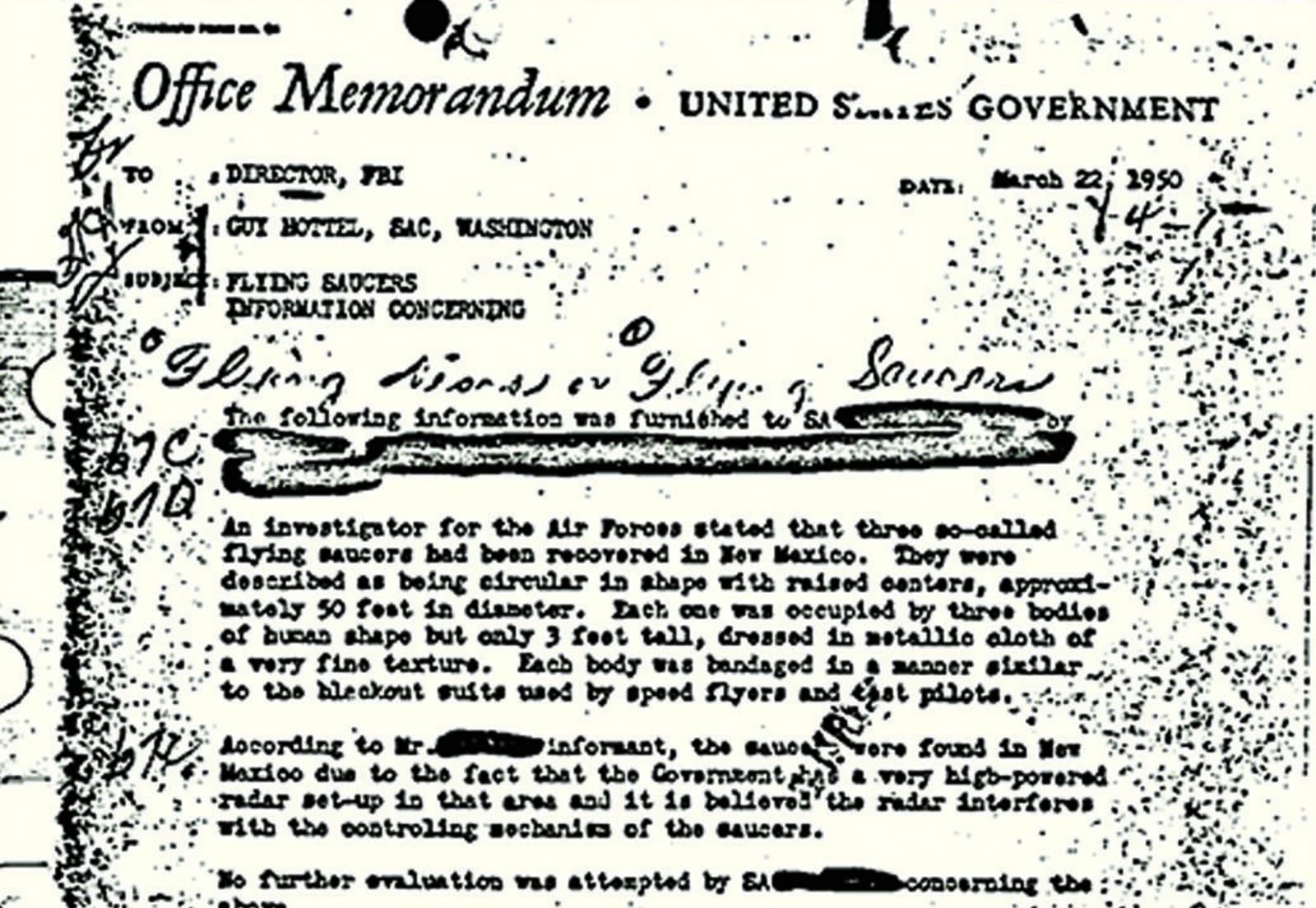
The Guy Hottel memo of March 22, 1950 is the single most-downloaded document on the FBI Vault, frequently cited in popular UFO culture as proof “the FBI confirmed alien bodies recovered in New Mexico.” It now appears in primary OCR’d form in 62-HQ-83894 Section 5 page 68, FBI serial 162-83894-209, stamped received March 23, 1950. The actual document context, read in the file as released by PURSUE on 2026-05-08, is the opposite of the popular reading. It is a single-page office memorandum from SAC Washington Guy Hottel to Director Hoover relaying a four-hop rumor with no investigative follow-up.
The relay chain is explicit on the page (68). An unnamed “investigator for the Air Forces” told Karl Howe, a Special Investigator on the Sex Squad of the District of Columbia Metropolitan Police Department. Howe told SA R. H. Kurtzman of the FBI Washington Field Office. Kurtzman reported it to SAC Hottel. Hottel forwarded it to Hoover. The substantive content describes “three so-called flying saucers” recovered in New Mexico, “circular in shape with raised centers, approximately 50 feet in diameter,” each “occupied by three bodies of human shape but only 3 feet tall, dressed in metallic cloth of a very fine texture,” each body “bandaged in a manner similar to the blackout suits used by speed flyers and test pilots.” A second paragraph attributes the recovery location to radar interference: “the Government has a very high-powered radar set-up in that area and it is believed the radar interferes with the controling mechanism of the saucers.”
The Bureau’s disposition is stated on the same page in one sentence: “No further evaluation was attempted by SA KURTZMAN concerning the above.” Hottel transmitted the rumor to Hoover anyway, as routine intelligence-relay traffic, with the standard recorded/indexed stamps and routing block. There is no follow-up correspondence in the section. A grep across the entire 2026-05-08 PURSUE release for “Hottel,” “Kurtzman,” “Karl Howe,” and “Sex Squad” returns only this single page. The substantive phrases (“three so-called flying saucers,” “approximately 50 feet in diameter,” “blackout suits,” “metallic cloth”) likewise appear nowhere else in the archive.
The popular-culture interpretation, then, inverts the document. The Hottel memo is one of the lowest-confidence single artifacts in 62-HQ-83894: a third-hand rumor (or fourth-hand, depending on whether the unnamed AAF investigator counts as a hop) filed with explicit “no further evaluation,” in a section dominated by higher-confidence material such as the Belmont / Twinkle correspondence, the Stuart Adcock Oak Ridge case, and the Pervier Tulsa case from the same window. The popular treatment of this single page as the headline FBI flying-saucer document is itself a finding about how the Vault is read.
What the Hottel Memo Documents
The chain of relay
Four explicit hops on the page, plus an unnamed initial source:
- Unnamed “investigator for the Air Forces” (the rumor’s stated origin)
- Karl Howe, Special Investigator, Sex Squad, Metropolitan Police Department (DC)
- SA R. H. Kurtzman, FBI Washington Field Office (the Bureau intake point)
- SAC Guy Hottel, FBI Washington (forwarder)
- Director J. Edgar Hoover (recipient)
The phrasing on the page is: “The following information was furnished to SA R. H. KURTZMAN by KARL HOWE, Special Investigator, Sex Squad, Metropolitan Police Department: An investigator for the Air Forces stated that…” Hottel does not attribute the rumor to any named AAF or Air Force source, and the document gives no indication that Howe’s “investigator” was identified to Kurtzman. The actionable source quality is closer to bar-talk than to inter-agency intelligence.
The substantive content
The descriptive paragraph reads in full (page 68):
An investigator for the Air Forces stated that three so-called flying saucers had been recovered in New Mexico. They were described as being circular in shape with raised centers, approximately 50 feet in diameter. Each one was occupied by three bodies of human shape but only 3 feet tall, dressed in metallic cloth of a very fine texture. Each body was bandaged in a manner similar to the blackout suits used by speed flyers and test pilots.
The “blackout suits” simile is the period-specific detail worth flagging. In 1950 the term referred to the G-suits and pressure suits worn by U.S. test pilots and high-altitude / high-speed flyers (the Berger anti-G suit, the partial-pressure suits then in development at Wright-Patterson). Whoever invented or repeated this rumor was reaching for a 1950 human-aviation analogy, not an exotic anatomical description. The “metallic cloth of a very fine texture” registers the same way: it describes the kind of garment a 1950 reader would associate with a high-altitude test pilot, transposed onto a 3-foot occupant.
The radar-interference attribution
The second substantive paragraph (page 68):
According to Mr. HOWE’S informant, the saucers were found in New Mexico due to the fact that the Government has a very high-powered radar set-up in that area and it is believed the radar interferes with the controling mechanism of the saucers.
The geographic placement is congruent with where the actual UAP-observation activity in 62-HQ-83894 is concentrated. The Belmont / Twinkle master-memo cluster (pass 11) and the Vital Installations / Project Twinkle correspondence (passes 9, 10) document AEC and Air Force concern about objects over Los Alamos, Sandia Base, White Sands, and Holloman through 1948–1950. Whoever invented this rumor placed the recovery in exactly the geography that 1950 inter-agency UAP-correspondence was already pre-occupied with. The “high-powered radar” detail also matches the Project Twinkle instrumented-watch concept being approved in this same window, where radar and theodolite stations were the proposed observation method.
The Bureau’s disposition
The closing sentence on page 68:
No further evaluation was attempted by SA KURTZMAN concerning the above.
This is the Bureau filing a rumor without analytical action. Hottel transmitted it to Hoover anyway. The page carries the usual administrative apparatus: typed initials “RHK:VIM,” “RECORDED - 3 / INDEXED - 3,” serial 162-83894-209 in red, “MAR 23 1950” intake stamp, and a later “MAR 29 1950” mark. There is no Hoover annotation on the page as released, no follow-up tasking, no Section 5 reference back to it elsewhere.
Routing and adjacency
Page 67 is a partial OCR of an earlier note (“Correspondence largely relates to…”). Page 69 is illegible — the OCR returns essentially a wall of [illegible] tokens, suggesting a heavily redacted or photo-degraded original; nothing readable can be tied to the Hottel memo from this page. Pages 70 and 71 step into the Oak Ridge classified-incoming-message traffic from early March 1950 (the Stuart Adcock cluster, pass 13), with serial 62-83894-210 immediately following the Hottel serial 209. The numerical adjacency and date adjacency confirm that pages 68 and 70-71 sit in the same intake week. The Pervier Tulsa cluster (pass 16) is also in this same Section 5 window. Pass 16 correctly flagged page 68 as adjacent to but not part of the Pervier sequence.
Why This Matters
-
Popular-culture significance is inverted. The Hottel memo became the most-downloaded FBI Vault document after Vault opened in 2011 and is routinely paraphrased online as “FBI memo confirms three flying saucers and alien bodies recovered in New Mexico.” The actual document is a four-hop rumor with explicit “no further evaluation.” Future readers of 62-HQ-83894 should not over-weight this single page on the strength of its public-search-engine ranking.
-
It is a representative artifact of mid-1950 institutional churn. Serial 162-83894-209 (Hottel, March 22), serial 62-83894-210 (Oak Ridge, March 7 intake, stuart-adcock-oak-ridge-march-1950), and the Pervier Tulsa traffic (pervier-tulsa-fbi-agent-corroboration-1950) cluster within weeks of each other. The same window produced the SAC San Antonio “Project Grudge” memo and the Cabell directive draft. The Hottel memo is one item in a heightened-volume moment, not the headline of it.
-
The Aztec / Frank Scully connection is plausible. The “three saucers, ~50 feet diameter, small humanoid bodies in metallic cloth” description tracks closely with the contemporaneous Aztec NM crash story that Variety columnist Frank Scully had been promoting since his late-1949 magazine columns and would book-publish as Behind the Flying Saucers in fall 1950. The Hottel memo predates the Scully book by about seven months but post-dates Scully’s lecture-circuit and column material. Whether the unnamed “investigator for the Air Forces” was downstream from Scully’s circuit, or whether Scully was downstream from the same rumor pool, is a citable historical question. (Note: a grep of the PURSUE release for “Aztec,” “Scully,” and “Behind the Flying Saucers” returns no hits, so this connection has to be made from outside the file.)
-
The Sex Squad relay-channel is the sociologically odd detail. The DC Metropolitan Police Department’s Sex Squad in 1950 was the morality-investigations unit (vice, prostitution, indecency cases). That a Sex Squad investigator was the relay node between an “Air Forces investigator” and the FBI Washington Field Office on a flying-saucer rumor is unusual and worth a footnote on inter-agency information-channel quality in this period. It says something about how saucer rumors moved through DC law-enforcement social networks rather than through formal inter-agency liaison.
-
The Bureau’s “no further evaluation” disposition has a counterpart. This is the same disposition documented at scale in the civilian-correspondence pattern (pass 17), where Hoover-directed responses politely declined to investigate public letters about saucer sightings. The Hottel memo applies the same logic to an inter-agency rumor relay: the Bureau filed it, recorded it, indexed it, and did not act on it.
-
The third-hand source quality is the operational counterexample to Cuneo. In the Cuneo / Jones case (cuneo-jones-winchell-followup-1949), a single phone call from a politically connected first-person source to D. M. Ladd produced a same-week federal background check across the country. The Hottel memo is the opposite end of the same spectrum: an institutional relay chain four hops deep, marked “no further evaluation,” filed and forgotten. The two cases together illustrate that what determined Bureau action in 1949–1950 saucer correspondence was source proximity, not source content.
-
The “metallic cloth” / “blackout suits” detail dates the rumor to 1950 human-aviation imagination. The vocabulary points to whoever invented or first transmitted the rumor reaching for the era’s high-altitude / test-pilot garment language (G-suits, pressure suits) and applying it to small occupants. This is a useful internal-consistency check: the rumor is a 1950 product, not a transmission from elsewhere.
-
Geographic congruence with actual UAP-observation activity is suggestive but not evidentiary. New Mexico in 1950 was where the actual instrumented watch (Project Twinkle) was being set up at White Sands and Holloman, where AEC was tracking green-fireball reports near Los Alamos / Sandia, and where the Vital Installations file material concentrated. A rumor placing the saucers there is not independent corroboration of anything; it is a rumor reaching for the same geography that the rest of the file was already pre-occupied with.
-
Scarce evidentiary value, despite the public profile. Treat the Hottel memo as a low-confidence single artifact. Do not chain claims off it. Do chain claims off the directly-corroborated FBI-agent traffic (Adcock, Pervier, Belmont/Twinkle) where the Bureau’s own personnel are sources of record.
Connections
- PURSUE full inventory
- PURSUE master report
- stuart-adcock-oak-ridge-march-1950
- pervier-tulsa-fbi-agent-corroboration-1950
- cuneo-jones-winchell-followup-1949
- civilian-correspondence-hoover-pattern-1949-1950
- belmont-twinkle-master-memo-osi-log-1949-1950
- UAP disclosure (concept)
Open Questions
- Who was the unnamed “investigator for the Air Forces”? The memo is silent. No Bureau follow-up attempted to identify him. No corresponding AAF / USAF document surfaces in 62-HQ-83894. This is the rumor’s anchor point and it is unfilled.
- What was Karl Howe’s actual relationship to the Sex Squad’s casework? Was the saucer rumor encountered in the course of a vice investigation, or was it social conversation between a DC police investigator and a friend who happened to be FBI? The page does not say.
- Did Hottel forward this because he believed it, or because the Bureau’s intake norm was to forward all flying-saucer rumors to the Director? The “no further evaluation” sentence reads as a hedge against the latter — Hottel disclaiming on Kurtzman’s behalf while still putting it on Hoover’s desk. A cross-check against other Hottel-to-Hoover memoranda from this window (search Section 5 for “Hottel” returns this single page; the broader file may have more) would clarify the routing norm.
Frank Scully’s circuit timing. Did Scully or anyone in his orbit have direct or indirect contact with Air Forces personnel or DC law enforcement in early 1950? This question sits outside the FBI file and would have to be answered from Scully’s papers, Variety columns, and contemporaneous lecture records.Partially resolved on pass 21. An in-archive Frank Scully reference does exist after all: the October 13, 1950 Hoover URGENT teletype to SAC Los Angeles (Section 6 page 22, FBI serial 62-83894-253) ordering Communist-affiliation cross-reference on the author of Behind the Flying Saucers, plus the October 31, 1950 case-file transfer to 100-2244-6 (Section 6 page 23). The reference is not about circuit timing — it is about cross-loading Scully against the LA Office’s pre-existing late-1930s Communist-activities subject file. See frank-scully-communist-teletype-october-1950. The original circuit-timing question (whether Scully had contact with AAF or DC law enforcement) remains open and outside this archive.- Why did Hoover not annotate the page? Hoover’s marginal annotations elsewhere in 62-HQ-83894 are frequent and sharp (see his “this should have been done the first thing monday” note in the Cuneo correspondence). The Hottel memo as released carries no Hoover handwriting. Was it filed without his personal review, or has the annotation been redacted on this release?
Quotes Worth Keeping
The following information was furnished to SA R. H. KURTZMAN by KARL HOWE, Special Investigator, Sex Squad, Metropolitan Police Department: (Hottel to Hoover, March 22, 1950, page 68)
An investigator for the Air Forces stated that three so-called flying saucers had been recovered in New Mexico. They were described as being circular in shape with raised centers, approximately 50 feet in diameter. (Hottel memo, page 68)
Each one was occupied by three bodies of human shape but only 3 feet tall, dressed in metallic cloth of a very fine texture. Each body was bandaged in a manner similar to the blackout suits used by speed flyers and test pilots. (Hottel memo, page 68)
According to Mr. HOWE’S informant, the saucers were found in New Mexico due to the fact that the Government has a very high-powered radar set-up in that area and it is believed the radar interferes with the controling mechanism of the saucers. (Hottel memo, page 68)
No further evaluation was attempted by SA KURTZMAN concerning the above. (Hottel memo, page 68 — the Bureau’s actual disposition, in one sentence)