FBI-62HQ-83894/kenneth-arnold-sighting-narrative-cascade-june-1947 / 1947-06-24 / Counter Intelligence Corps (4AF CIC), Hamilton Field — Kenneth Arnold (Exhibit A, first-person typed narrative)
Kenneth Arnold Sighting Narrative, Cascade Mountains June 24, 1947 (First-Person Account, Exhibit A, Nine-Object Formation, Corroborating Witnesses Named, Yakima-Pendleton Chain)
Classified CONFIDENTIAL COPY, filed as Exhibit A to CIC case 4AF-1208-I (FBI serial 62-83894-95), Section 2 pages 164-167.
Counter Intelligence Corps (4AF CIC), Hamilton Field — Kenneth Arnold (Exhibit A, first-person typed narrative) (1947). Kenneth Arnold Sighting Narrative, Cascade Mountains June 24, 1947 (First-Person Account, Exhibit A, Nine-Object Formation, Corroborating Witnesses Named, Yakima-Pendleton Chain). The UFO Files. https://the-ufo-files-site.netlify.app/dossier/kenneth-arnold-sighting-narrative-cascade-june-1947
"Kenneth Arnold Sighting Narrative, Cascade Mountains June 24, 1947 (First-Person Account, Exhibit A, Nine-Object Formation, Corroborating Witnesses Named, Yakima-Pendleton Chain)." Counter Intelligence Corps (4AF CIC), Hamilton Field — Kenneth Arnold (Exhibit A, first-person typed narrative). 1947. https://the-ufo-files-site.netlify.app/dossier/kenneth-arnold-sighting-narrative-cascade-june-1947.
Kenneth Arnold Sighting Narrative, Cascade Mountains June 24, 1947 (First-Person Account, Exhibit A, Nine-Object Formation, Corroborating Witnesses Named, Yakima-Pendleton Chain)
Case ID: FBI-62HQ-83894/kenneth-arnold-sighting-narrative-cascade-june-1947
Agency: Counter Intelligence Corps (4AF CIC), Hamilton Field — Kenneth Arnold (Exhibit A, first-person typed narrative)
Date: 1947-06-24
Source: https://www.war.gov/medialink/ufo/release_1/65_hs1-834228961_62-hq-83894_section_2.pdf
Retrieved: Fri May 08 2026 20:00:00 GMT-0400 (Eastern Daylight Time)
Mirrored on The UFO Files, an archive by Dead Pixel Design. The file is the file. Anything in question is one click from the original.
Summary
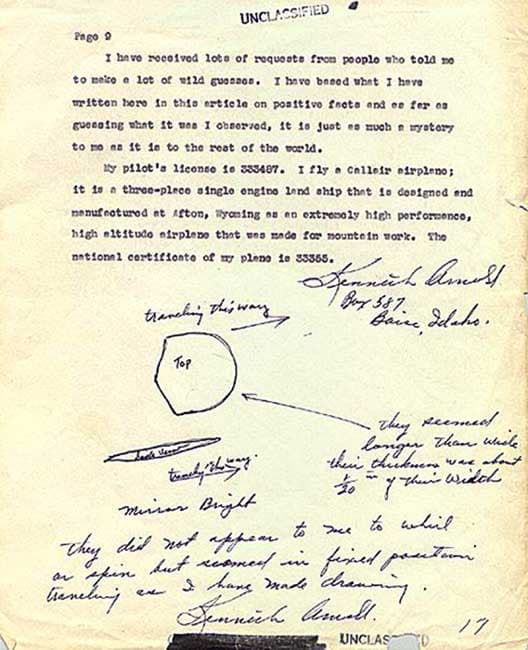
Classified CONFIDENTIAL COPY, filed as Exhibit A to CIC case 4AF-1208-I (FBI serial 62-83894-95), Section 2 pages 164-167. Kenneth Arnold’s first-person typed narrative account of his June 24, 1947 aerial observation over the Cascade Mountains of Washington State — the sighting conventionally dated as the origin event of the modern UAP era. The narrative spans four pages and covers: the context of the flight (marine transport search mission, Chehalis-to-Yakima route at 9,200-9,500 feet), the initial reflection event and identification of nine objects in formation traveling north-to-south at approximately 9,500 feet, Arnold’s timing methodology and speed computation (1 minute 42 seconds over a measured 5-mile baseline, computing to approximately 1,200 mph), his shape analysis (tailless, saucer-like when seen against snow, thin black line when viewed flat), his observations of movement pattern (diagonal chain formation, swerving between mountain peaks, consistent altitude), his post-landing reports to Al Baxter at Yakima Airport and to pilot contacts at Pendleton Oregon (including a named direct-quotation from former Army Air Forces pilot Sonny Robinson), his assessment of corroborating accounts from other observers (Cedar City Utah Western Airlines employees, Oklahoma City witness, Illinois locomotive engineer, Captain E. J. Smith and Co-Pilot Stevens of United Air Lines), and his conviction that the objects were “some type of airplane” rather than rockets, artillery shells, or natural phenomena. Page 167 closes with Arnold’s signed hand-drawn diagram of the objects showing top and side view, with notation that the objects were “mirror bright” and “seemed longer than wide, their thickness was about 1/20th of their width.” The narrative was written prior to the July 12, 1947 interview at which Brown received it as Exhibit A.
What the Documents Show
The Flight Context and the First Observation
Arnold departed Chehalis, Washington, at approximately 2:00 PM on June 24, 1947, from the Central Air Service, intending to fly to Yakima, Washington. His departure was delayed by an hour to search for a missing large marine transport reportedly down on the southwest side of Mt. Rainier — a search task that positioned him at 9,200-9,500 feet above the Cascade high plateau.
The observation began with a bright flash reflecting off Arnold’s airplane that initially alarmed him as proximity to another aircraft. Looking to the left and north of Mt. Rainier, he observed a chain of nine peculiar-looking aircraft flying from north to south at approximately 9,500 feet, approaching in a direction of approximately 170 degrees (south-southeast). Two or three of them every few seconds were dipping or changing course slightly enough for sunlight to reflect brightly off them, creating the reflection he had first noticed.
The DC-4 he had noticed earlier was approximately fifteen miles to his left and rear at 14,000 feet — this detail establishes Arnold’s relative position and provides an angular-size reference he subsequently used.
Shape Analysis: What Arnold Actually Described
The shape question dominates public accounts of the sighting but Arnold’s first-person account is precise and conditional:
- When the objects flew approximately level, they appeared as “a black thin line.”
- When they reflected direct sunlight off their surfaces, they appeared “completely round.”
- As they passed against snow-covered ridges, Arnold could observe their outline and noted he “couldn’t find their tails” — which he found so anomalous he thought about it explicitly.
- In his hand-drawn diagram (page 167), Arnold sketched both top and side views, noting the objects were “longer than wide, their thickness was about 1/20th of their width” — indicating a flattened horizontal profile, not a circular disc as commonly cited. He noted they were “mirror bright” and “did not appear to me to whirl or spin but seemed in fixed position.”
- For angular size comparison, Arnold held up a “zeus fastener or cowling tool” from his pocket against the objects and against the DC-4 to compare: the objects appeared smaller than the DC-4, but with an estimated span “as wide as the furthest engines on each side of the fuselage of the DC-4.”
Arnold explicitly addresses the “reflections or mirage” interpretation raised by news media, noting he observed the objects both through his aircraft’s glass and after opening his window for an unobstructed view without sunglasses.
The Timing and Speed Computation
Arnold established two timing points anchored to observable features: the first object passing the southern edge of Mt. Rainier (his clock reading one minute to 3:00 PM) and the last object passing the southernmost crest of Mt. Adams. His sweep-second-hand reading at the end gave an elapsed time of one minute and forty-two seconds.
He states he subsequently measured the distance between the two mountains and found it to be approximately five miles. From one minute forty-two seconds over five miles, the computed speed is approximately 1,200 mph — well in excess of any known operational aircraft in 1947.
Arnold also noted that the formation’s leading edge to trailing edge, measured against the same snow ridge, was also approximately five miles — meaning the chain of nine objects occupied a five-mile front.
The objects flew “like geese fly in a rather diagonal chain-like line as if they were linked together,” maintaining a definite direction while swerving in and out of high mountain peaks. Their elevation was “pretty much on the horizon” relative to Arnold’s position — approximately the same altitude as he was flying.
Post-Sighting Chain: Yakima and Pendleton
Arnold continued his marine transport search for another twenty minutes before heading to Yakima. On landing at Yakima, he described the observation to Al Baxter (“who listened patiently and was very courteous but in a joking way didn’t believe me”).
At Pendleton, Oregon, the same day, Arnold told a number of pilot friends. The response there was different: “they did not scoff or laugh but suggested they might be guided missiles or something new.” Several former Army Air Forces pilots told him they had been briefed before going into combat overseas that they might see objects “of similar shape and design” as Arnold described. Sonny Robinson, a former AAF pilot then operating dusting operations at Pendleton, gave Arnold the statement Arnold quotes directly:
“What you observed, I am convinced, is some type of jet or rocket propelled ship that is in the process of being tested by our government or even it could possibly be by some foreign government.”
News of what Arnold had observed “spread very rapidly and before night was over I was receiving telephone calls from all parts of the world.” Arnold notes he received no phone call or letter of disbelief from direct contacts — only disbelief in the printed press.
Corroborating Accounts Arnold Identifies
Arnold names six corroborating observer accounts he considers credible at the time of writing:
- Three Cedar City, Utah, Western Airlines pilot employees.
- “The gentleman from Oklahoma City.”
- The locomotive engineer in Illinois.
- Captain E. J. Smith and Co-Pilot Stevens of United Air Lines (Smith’s July 4, 1947 sighting, which Brown would interview him about at Boise Municipal Airport in the same CIC cluster).
Arnold provides a measured assessment of ground-observation limitations: from the ground, an observer would have had “four or five seconds” to observe objects at the kind of altitude and speed he recorded, and atmospheric moisture and dust near the ground could distort vision. He indicates he has received letters from people who report observations from Sweden, Bermuda, and California.
Arnold’s Own Assessment
Arnold is explicit about his conviction and his uncertainty. He states he is “convinced in my own mind that they were some type of airplane, even though they didn’t conform with the many aspects of the conventional type of planes that I know.” He specifically rules out rockets or artillery shells based on the objects’ consistent altitude (not ascending or descending).
He notes that he “openly invited an investigation by the Army and the FBI as to the authenticity of my story or a mental or a physical examination as to my capabilities” and had received “no interest from these two important protective forces of our country” — a complaint that the SAC SF transmittal cover letter (page 159) specifically registers for the Director’s attention.
He closes:
“I look at this whole ordeal as not something funny as some people have made it out to be. To me it is mighty serious and since I evidently did observe something that at least Mr. John Doe on the street corner or Pete Andrews on the ranch has never heard about, is no reason that it does not exist.”
Why This Matters
-
Primary-Source First-Person Text of the Foundational Modern UAP Sighting — This is Kenneth Arnold’s own typed first-person account, filed as a federal intelligence document twelve days after the event, in the same archive as the investigation it triggered. Not a newspaper paraphrase, not a later memoir reconstruction, not a 35-month-remove retelling.
-
Shape Description vs. Popular Narrative — Arnold’s actual language describes a flattened object “longer than wide” with thickness “1/20th of their width” that appeared round only when reflecting direct sunlight. He does not describe classic flying saucers — he describes the motion as “like a saucer would if you skipped it across water.” The conflation of his motion metaphor with disc-shape is a press construction, not Arnold’s own description. The page-167 diagram is the documentary corrective.
-
Speed Computation Method Documented — Arnold describes his timing methodology (sweep-second-hand clock on instrument panel, two specific landmark endpoints, post-landing measurement of the inter-mountain distance). The computation is reproducible: one minute 42 seconds / approximately 5 miles = approximately 1,200 mph. Brown’s chart-check confirmed this computation was internally consistent with the known geography.
-
Named Living Corroborators at Time of Writing — Arnold names Captain E. J. Smith and Co-Pilot Stevens of United Air Lines, the Cedar City Western Airlines employees, the Oklahoma City witness, and the Illinois locomotive engineer. Smith was interviewed by Brown on the same day as the Arnold interview (during a Boise Municipal Airport stopover). Arnold’s document is not self-referential — he names verifiable contemporaneous observers.
-
Sonny Robinson’s Direct Quotation: Military-Pilot Attribution Baseline — The Robinson quote is the first appearance of what would become the dominant institutional hypothesis (government test program) in primary form, attributed by name to a former AAF pilot, recorded in Arnold’s own contemporaneous account. Robinson’s specific phrasing (“in the process of being tested by our government or even it could possibly be by some foreign government”) captures both the domestic-classified and foreign-origin hypotheses that Bureau and military investigations would pursue over the next three years.
-
Pre-Roswell Context: Arnold Sought Investigation Before Roswell — Arnold explicitly states he invited Army and FBI investigation and received no response. This predates Roswell by three weeks. The institutional non-response to the first documented mass-media UAP event in postwar America is here in writing, in the subject’s own words, before the event that triggered the Bureau’s actual policy engagement (Bureau Bulletin #42, July 30, 1947).
-
The Marine Transport Context — Arnold was not sightseeing; he was on a paid search mission for a missing marine transport. His route to 9,500 feet over the Cascade high plateau was task-driven, not recreational. The search context explains his navigation along the ridge systems where he made the observation and establishes his operational rationale for being at that exact altitude and position.
-
Hand-Drawn Diagram as Primary Physical Evidence — Page 167 closes with Arnold’s signed hand-drawn diagram showing top and side views of the objects, with his handwritten annotations about the thickness ratio, travel direction, and surface quality (“mirror bright”). This is the earliest primary-source diagram of a modern UAP observation in the federal archive — a geometric characterization by the witness in his own hand, signed.
Connections
- kenneth-arnold-biographical-statement-1947 — Arnold’s biographical statement (Section 2 page 163), the companion credentialing preface submitted with this narrative
- springer-brown-cic-cluster-pre-maury-island-1947 — the 30-page Hamilton Field CIC cluster this document is Exhibit A of; includes Brown’s evaluative posture in writing
- maury-island-1947 — three weeks after Brown received this document, Brown and Davidson died on the Maury Island return flight; this is the last substantive document Brown handled in his UAP investigation
- dewayne-johnson-ucla-dissertation-arnold-second-pass-1950 — second-pass first-person Arnold sighting narrative at 35-month remove (Section 5 page 161); compare quantitative parameters for consistency
- wenyon-rehoboth-delaware-1946 — Wenyon’s pre-Arnold sightings (September 1946, June 2, 1947) as pre-existing data points Arnold could not have known
- section-2-1947-multi-case-extension-and-wenyon-pre-roswell — multiple Section 2 1947 cases filed alongside this document in the same CIC cluster
- PURSUE full inventory
Open Questions
-
The Missing Marine Transport — Arnold was searching for a large marine transport reportedly down on the southwest side of Mt. Rainier. The narrative notes it “has never been found.” Was it subsequently recovered? Which vessel? Is there a separate CIC or Coast Guard file?
-
Arnold’s Post-Pendleton Documentation — Arnold states he received telephone calls from “all parts of the world” by that night and had received no letter or call of disbelief from personal contacts. Did he retain records of this correspondence? Any of it filed in subsequent FBI archives?
-
The Cedar City Utah Western Airlines Employees — Arnold names three employees who he says must have observed the same thing. Were they interviewed by CIC, FBI, or AAF? Are their accounts filed in 62-HQ-83894 or in other federal archives?
-
Sonny Robinson’s Briefing Claim — Robinson stated former Army pilots had been briefed before overseas combat that they might see objects “of similar shape and design” as Arnold described. This is a significant claim. Is Robinson documented in any CIC, G-2, or Army Air Forces investigation file from 1947? Was his briefing claim ever verified?
-
Al Baxter’s Disbelief — Arnold describes Baxter as “courteous but in a joking way didn’t believe me.” Was Baxter interviewed by CIC investigators in the same cluster? His response immediately post-sighting, before press attention, would be a calibration data point.
-
The Speed Baseline Measurement — Arnold states he “measured” the Mt. Rainier-to-Mt. Adams distance after landing at Pendleton. By what method? Aeronautical charts? If charts, which edition? The distance variable is load-bearing for the speed computation and worth clarifying from Arnold’s own measurement documentation.
-
The Hand-Drawn Diagram’s Physical Status — Page 167 contains a description of the diagram. Was the original diagram retained at Hamilton Field? Is it preserved in a separate physical evidence archive? The OCR’d version captures the annotations but not the drawing itself at resolution sufficient for shape analysis.
Quotes Worth Keeping
“I thought it was very peculiar that I couldn’t find their tails but assumed they were some type of jet plane.” — Kenneth Arnold, Exhibit A, Section 2 page 164. Arnold’s first diagnostic observation — the absence of empennage as the anomaly that defined the encounter.
“I observed the chain of these objects passing another high snow-covered ridge in between Mt. Rainier and Mt. Adams, and as the first one was passing the south crest of this ridge the last object was entering the northern crest of the ridge. As I was flying in the direction of this particular ridge, I measured it and found it to be approximately five miles so I could safely assume that the chain of these saucer like objects were at least five miles long.” — Kenneth Arnold, Exhibit A, Section 2 page 165. The formation-length computation.
“When these objects were flying approximately straight and level, they were just a black thin line and when they flipped was the only time I could get a judgment as to their size.” — Kenneth Arnold, Exhibit A, Section 2 page 166. The primary shape characterization — flat aspect, not a disc.
“I am convinced in my own mind that they were some type of airplane, even though they didn’t conform with the many aspects of the conventional type of planes that I know.” — Kenneth Arnold, Exhibit A, Section 2 page 166. Arnold’s own interpretive conclusion in primary form.
“What you observed, I am convinced, is some type of jet or rocket propelled ship that is in the process of being tested by our government or even it could possibly be by some foreign government.” — Sonny Robinson, former AAF pilot, Pendleton Oregon, as quoted by Kenneth Arnold, Exhibit A, Section 2 page 166. The first named attribution of the government-test-program hypothesis in primary federal-document form.
“I look at this whole ordeal as not something funny as some people have made it out to be. To me it is mighty serious.” — Kenneth Arnold, Exhibit A, Section 2 page 167. Arnold’s closing framing.
“They seemed longer than wide, their thickness was about 1/20th of their width.” — Kenneth Arnold, hand-drawn diagram annotation, Section 2 page 167. The most precise primary-source shape description Arnold provided, in his own handwriting on the diagram submitted to federal investigators.