FBI-62HQ-83894/kenneth-arnold-biographical-statement-1947 / 1947-07-12 / State Department
Kenneth Arnold Biographical Statement, 1947 (SOME LIFE DATA ON KENNETH ARNOLD — Eagle Scout, Olympic Diving Trials, Fire Control Engineer, 1,000-Hour Mountain Pilot)
Classified CONFIDENTIAL COPY, filed as Enclosure to CIC case 4AF-1208-I (FBI serial 62-83894-95), Section 2 page 163. A first-person typed autobiographical statement by Kenneth Arnold, titled "SOME LIFE DATA ON KENNETH ARNOLD," submitted to 4AF CIC Special Agent Frank M.
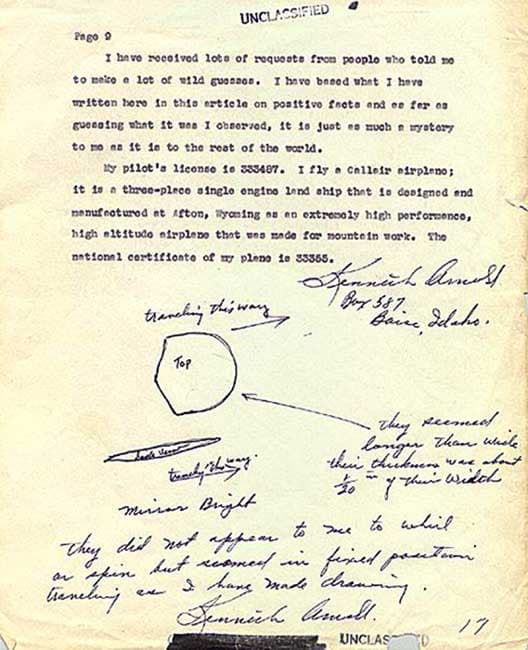
Counter Intelligence Corps (4AF CIC), Hamilton Field — Kenneth Arnold (first-person typed statement) (1947). Kenneth Arnold Biographical Statement, 1947 (SOME LIFE DATA ON KENNETH ARNOLD — Eagle Scout, Olympic Diving Trials, Fire Control Engineer, 1,000-Hour Mountain Pilot). The UFO Files. https://the-ufo-files-site.netlify.app/dossier/kenneth-arnold-biographical-statement-1947
"Kenneth Arnold Biographical Statement, 1947 (SOME LIFE DATA ON KENNETH ARNOLD — Eagle Scout, Olympic Diving Trials, Fire Control Engineer, 1,000-Hour Mountain Pilot)." Counter Intelligence Corps (4AF CIC), Hamilton Field — Kenneth Arnold (first-person typed statement). 1947. https://the-ufo-files-site.netlify.app/dossier/kenneth-arnold-biographical-statement-1947.
Kenneth Arnold Biographical Statement, 1947 (SOME LIFE DATA ON KENNETH ARNOLD — Eagle Scout, Olympic Diving Trials, Fire Control Engineer, 1,000-Hour Mountain Pilot)
Case ID: FBI-62HQ-83894/kenneth-arnold-biographical-statement-1947
Agency: Counter Intelligence Corps (4AF CIC), Hamilton Field — Kenneth Arnold (first-person typed statement)
Date: 1947-07-12
Source: https://www.war.gov/medialink/ufo/release_1/65_hs1-834228961_62-hq-83894_section_2.pdf
Retrieved: Fri May 08 2026 20:00:00 GMT-0400 (Eastern Daylight Time)
Mirrored on The UFO Files, an archive by Dead Pixel Design. The file is the file. Anything in question is one click from the original.
Summary
Classified CONFIDENTIAL COPY, filed as Enclosure to CIC case 4AF-1208-I (FBI serial 62-83894-95), Section 2 page 163. A first-person typed autobiographical statement by Kenneth Arnold, titled “SOME LIFE DATA ON KENNETH ARNOLD,” submitted to 4AF CIC Special Agent Frank M. Brown during Arnold’s July 12, 1947 interview at Boise, Idaho. The document establishes Arnold’s complete biographical record — family origin, amateur athletics (Eagle Scout at 14, U.S. Olympic fancy diving trials 1932, all-state football 1932-33, dog-sled derby champion 1930), education at the University of Minnesota, and a commercial career spanning eight years in fire suppression equipment across five western states, plus three years of intensive mountain flying in specialized equipment — as the institutional baseline for evaluating Arnold as a credible civilian witness to the June 24, 1947 Mt. Rainier sighting. The statement is Arnold’s own construction. It was filed together with Arnold’s four-page sighting narrative (Exhibit A, pages 164-167) and Brown’s evaluative memorandum (page 162) as a single enclosure. The document contains no reference to the June 24 sighting — it is entirely devoted to establishing who Arnold was before the sighting occurred.
What the Documents Show
Origin, Family, and Political Standing
Arnold was born March 29, 1915, in Subeka, Minnesota. His family relocated to Scobey, Montana, when he was six years old, where both his father (Edward Erb Arnold) and his paternal grandfather (Roland C. Arnold) homesteaded. The grandfather became prominent in Montana political circles, specifically in association with Senator Burton K. Wheeler — a detail Arnold included deliberately, establishing family connection to federal political standing at the highest level Montana offered in the 1920s. Wheeler was one of the most prominent progressive senators of the era, known for his investigation of the Department of Justice and his opposition to FDR’s court-packing plan.
Arnold attended grade school and high school in Minot, North Dakota. He entered scouting at age twelve and achieved Eagle Scout rank before fourteen. His former scout executive, H. H. Prescott, was at the time of the statement serving as a regional commissioner for the Boy Scouts in Kansas City, Kansas — a named living reference Arnold provides, checkable by any investigator.
Athletics and Physical Credibility
The athletics section is the most extensive portion of the biographical statement, proportionally. Arnold was:
- Selected all-state end in football for North Dakota, 1932 and 1933.
- An entrant in the U.S. Olympic diving trials in fancy diving, 1932.
- A Red Cross Life Saving Examiner in 1932, 1933, and 1934.
- A swimming and diving instructor at scout camps and the municipal pool in Minot, North Dakota.
- A University of Minnesota athlete under swimming coach Neils Thorpe and football coach Bernie Bierman — Bierman won national championships at Minnesota in the 1930s and is one of the most documentable coaches in the institution’s history.
- First-place finisher in the Lions Club Dog Derby, Minot, North Dakota, 1930.
- A football player whose career ended at Minnesota due to a knee injury; his high school coach Glenn L. Jarrett was at the time of writing the head football coach at the University of North Dakota.
The weight of this section is in its verifiability and temporal reach: the athletic record runs from 1930 through 1934, with named officials, named institutions, and named coaches all still in position at the time of writing. Any one of these could confirm the profile. Brown’s subsequent evaluation of Arnold notes Arnold’s intelligence and integrity — the biographical statement provided Brown the raw material for that assessment.
Commercial Career: Fire Control Engineering
Arnold’s commercial career began in 1938 with Red Comet, Inc. of Littleton, Colorado, a manufacturer of automatic fire fighting apparatus. By 1939 he was district manager for part of the western states. In 1940 he established his own company, Great Western Fire Control Supply, and operated as an independent fire control engineer for seven years at time of statement. His territory covered five western states; he handled, distributed, sold, and installed all types of automatic and manual fire-fighting equipment in rural areas.
This establishes Arnold as a traveling sales and technical engineer with broad geographic coverage in remote terrain — a person for whom familiarity with variable weather, extreme conditions, and emergency situational judgment was occupational baseline, not exceptional.
Flying: The Operational Record
Arnold’s flying career had two phases. His first lesson was from Earl T. Vance in Minot, North Dakota (originally of Great Falls, Montana). High cost prevented continuation. He did not fly consequentially until 1943, when he received his pilot certificate from Ed Leach, a senior Civil Aeronautics Authority (CAA) inspector based in Portland, Oregon.
For the three years preceding the statement (1944-1947), Arnold owned his own airplane and was flying 40 to 100 hours per month, using the aircraft entirely in his commercial work across his five-state territory. In January 1947 — five months before the Mt. Rainier sighting — he purchased a new Callair airplane, specifically engineered for high-altitude takeoffs and short rough-field use, manufactured in Afton, Wyoming.
The signature quantitative detail: Arnold had logged 823 cow-pasture and mountain-meadow landings in over 1,000 hours of flying, and in all of those hours “a flat tire has been my greatest mishap.” This is the operational summary of a pilot who worked in extreme conditions without incident — a direct implicit argument against perceptual error in the June 24 observation.
His CAA pilot’s license number is recorded in the associated narrative document: 333487. Aircraft national certificate: 33355.
The Institutional Frame
The document is stamped CONFIDENTIAL COPY and carries the case reference 62-83894-95 ENCLOSURE. It was submitted in the context of Brown’s interview of Arnold on July 12, 1947 — twelve days after the sighting. Arnold constructed the document himself and typed it personally (the quality and format match the other Arnold documents in the cluster). This authorial agency distinguishes it from standard FBI witness statements, which are interviewer-transcribed. Arnold chose what to include. His choices — Olympic trials, Eagle Scout, grandfather’s connection to a U.S. Senator, Callair engineering specifications, the flat-tire quantification — reflect a sophisticated understanding of what federal investigators evaluate as credibility markers.
Why This Matters
-
Credibility Architecture, Arnold’s Own Construction — Arnold wrote this document himself. The selection of details — Olympic-level athletic record, named living references at every level, eight years of commercial fire-control engineering, 1,000+ flight hours without incident — constitutes Arnold’s own theory of what would persuade institutional investigators. It is not a standard FBI intake form; it is a case for credibility assembled by the witness, filed alongside the sighting narrative.
-
Institutional Baseline for the Modern UFO Era’s Foundational Sighting — The June 24, 1947 Mt. Rainier sighting is conventionally treated as the starting point of the modern UAP era. The biographical statement is the FBI/CIC’s foundational document for assessing the credibility of the witness to that event. Brown’s chart-check finding (“could very possibly be facts”) and evaluative posture (“he should be writing Buck Rogers fiction” if he didn’t see what he reported) rest on this biographical record.
-
Counter to Existing Press Ridicule — Brown’s cover memo (page 162) notes Arnold’s bitterness that “he has been ridiculed by the press to such an extent that he is practically a moron in the eyes of the majority of the population of the United States.” The biographical statement was written inside that media environment. Arnold constructed it knowing the dominant public narrative already framed him as unreliable; the document is a systematic rebuttal using verifiable institutional markers.
-
Named Living References Throughout — The document provides H. H. Prescott (Boy Scouts KC Kansas), Glenn L. Jarrett (U of North Dakota head football coach), Ed Leach (senior CAA inspector Portland OR), Earl T. Vance (first flying instructor, originally Great Falls MT), Neils Thorpe (U of Minnesota swim coach), Bernie Bierman (U of Minnesota football coach). Each is checkable in 1947 institutional records.
-
The Callair as Operational Specificity — Arnold’s January 1947 purchase of a Callair — a high-altitude mountain-work aircraft — is a detail that anchors the June 24 observation in concrete professional context. The Callair’s design parameters (high-altitude takeoff, short rough-field use, engineered for mountain terrain) are exactly the operational context in which the Mt. Rainier sighting occurred at 9,200-9,500 feet above terrain Arnold had flown 1,000+ hours across.
-
823 Cow-Pasture Landings — This figure is verifiable in principle through insurance records, maintenance logs, and CAA records. A fabricating witness would not insert a claim precisely this checkable. Arnold’s inclusion of it is functionally an invitation to verify his operational record.
-
Political Connection — Roland C. Arnold / Burton K. Wheeler — Arnold mentions his grandfather’s connection to U.S. Senator Burton K. Wheeler specifically. This is a signal of comfort with federal institutional engagement and an implicit reference to political standing at the level that would matter to investigators reading a federal CIC document.
-
Deliberate Separation of Biography from Sighting Narrative — The biographical statement contains no reference to the June 24 sighting. Arnold’s sighting narrative (pages 164-167) contains no self-promotion or biographical credentialing. The two documents together constitute a deliberate separation between “who I am” and “what I saw” — itself a marker of reliability in witness testimony, and a structural choice not seen in other witness accounts in the same CIC cluster.
Connections
- springer-brown-cic-cluster-pre-maury-island-1947 — the 30-page Hamilton Field CIC cluster this document is part of (Brown’s interview memo, Exhibit A, Exhibit B, Smith and Baker interviews)
- kenneth-arnold-sighting-narrative-cascade-june-1947 — Arnold’s contemporaneous first-person sighting narrative (Exhibit A, pages 164-167), the companion document to this biographical statement
- maury-island-1947 — three weeks after this interview, Brown and Davidson died on the Maury Island return flight; this document predates that event
- dewayne-johnson-ucla-dissertation-arnold-second-pass-1950 — second-pass preservation of the Arnold sighting narrative at 35-month remove via UCLA dissertation submission, confirming the biographical and observational record held consistent
- wenyon-rehoboth-delaware-1946 — Wenyon’s pre-Arnold sightings, for which no institutional credibility assessment was attempted; contrast with this document’s systematic credential architecture
- PURSUE full inventory
Open Questions
-
Verification Record — Did Brown or any subsequent CIC investigator verify any biographical claims? Named references (Prescott, Jarrett, Leach, Vance, Thorpe, Bierman) are all checkable. Is there investigative follow-up in the archive tracing one of these reference points?
-
Callair Aircraft Records — CAA registration 33355 is cited in the narrative. CAA records from 1947 at the National Archives would confirm Arnold’s ownership, aircraft type, and registration date. What happened to the aircraft after 1947?
-
Olympic Diving Trials, 1932 — U.S. Olympic diving trial records from 1932 exist. Is Arnold documented there? The claim is specific and verifiable; confirmation would add a tier to the credibility architecture independent of the federal record.
-
Dog Derby, 1930 — The Lions Club Dog Derby, Minot, North Dakota, 1930. Arnold placed first. Local newspaper archives in Minot would have records. Is he documented there?
-
Why a Biographical Statement? — Brown’s interview methodology across the cluster (Johnson, Smith, Baker, Ryherd) does not produce biographical statements from any other subject. Arnold is the only subject who produced one. Did Brown request it, or did Arnold volunteer it independently? The document’s existence as a self-generated credential preface is structurally unique in the CIC cluster.
Quotes Worth Keeping
“I entered the U. S. Olympic trials in fancy diving in 1932; I was a Red Cross Life Saving Examiner during the years of 1932, ‘33 and ‘34.” — Kenneth Arnold, “Some Life Data on Kenneth Arnold,” Section 2 page 163. Filed as enclosure to CIC case 4AF-1208-I, FBI serial 62-83894-95.
“In the type of flying I do, it takes a great deal of practice and judgment to be able to land in most any cow pasture and get out without injuring my airplane; the runways are very limited and the altitude is very high in some of the fields and places I have to go in my work. To date, I have landed in 823 cow pastures in mountain meadows, and in over a thousand hours a flat tire has been my greatest mishap.” — Kenneth Arnold, “Some Life Data on Kenneth Arnold,” Section 2 page 163.
“My grandfather, Roland C. Arnold also homesteaded in Scobey, Montana, and became quite prominent in political circles along with Burton K. Wheeler, the famous Montana senator.” — Kenneth Arnold, “Some Life Data on Kenneth Arnold,” Section 2 page 163. Political-standing signal embedded in a biographical preface to a federal intelligence document.
“I was given my pilot certificate by Ed Leach, a senior CAA inspector of Portland, Oregon, and for the last three years have owned my own airplane covering my entire territory with same and flying from forty to one hundred hours per month since.” — Kenneth Arnold, “Some Life Data on Kenneth Arnold,” Section 2 page 163.