FBI-62HQ-83894/air-defense-command-institutional-baseline-policy-february-1948 / 1948-02-04 / Air Force
Air Defense Command Institutional Baseline Policy on Flying Disc Investigations, February 4, 1948 (Dismissal Threshold, Military Investigation Protocol, FBI Coordination)
On February 4, 1948, Air Defense Command headquarters (Mitchel AFB, New York) issued a classified policy directive establishing the institutional baseline for how the numbered air forces under its command would investigate and report flying disc incidents.
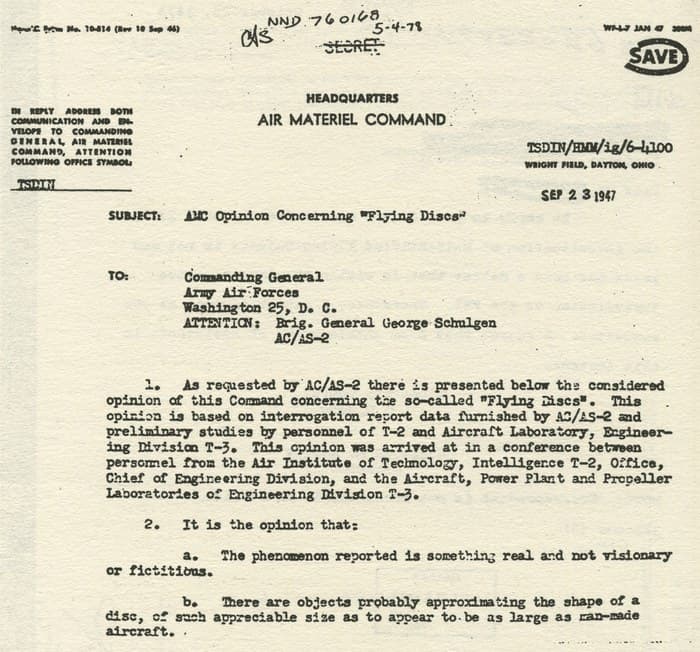
Air Defense Command, Mitchel Air Force Base (1948). Air Defense Command Institutional Baseline Policy on Flying Disc Investigations, February 4, 1948 (Dismissal Threshold, Military Investigation Protocol, FBI Coordination). The UFO Files. https://the-ufo-files-site.netlify.app/dossier/air-defense-command-institutional-baseline-policy-february-1948
"Air Defense Command Institutional Baseline Policy on Flying Disc Investigations, February 4, 1948 (Dismissal Threshold, Military Investigation Protocol, FBI Coordination)." Air Defense Command, Mitchel Air Force Base. 1948. https://the-ufo-files-site.netlify.app/dossier/air-defense-command-institutional-baseline-policy-february-1948.
Air Defense Command Institutional Baseline Policy on Flying Disc Investigations, February 4, 1948 (Dismissal Threshold, Military Investigation Protocol, FBI Coordination)
Case ID: FBI-62HQ-83894/air-defense-command-institutional-baseline-policy-february-1948
Agency: Air Defense Command, Mitchel Air Force Base
Date: 1948-02-04
Source: https://www.war.gov/medialink/ufo/release_1/65_hs1-834228961_62-hq-83894_section_4.pdf
Retrieved: Fri May 08 2026 20:00:00 GMT-0400 (Eastern Daylight Time)
Mirrored on The UFO Files, an archive by Dead Pixel Design. The file is the file. Anything in question is one click from the original.
Summary
On February 4, 1948, Air Defense Command headquarters (Mitchel AFB, New York) issued a classified policy directive establishing the institutional baseline for how the numbered air forces under its command would investigate and report flying disc incidents. The directive established a dismissal threshold: “Futile expenditure of military funds and manpower must be avoided.” It created a formal heuristic for investigation prioritization: if “there is a reasonable indication that a reported incident is a hoax or the fabrication of a publicity seeking individual, no further investigative effort will be expended.” The policy required coordination with FBI offices and established that hoax-identified cases would be reported to the FBI but would receive no military follow-up. This policy memo represents the institutional dismissal baseline against which subsequent Hoover-level personal engagement (July 1949 onward) and Air Force escalation protocols must be measured. The directive also authorized use of Counter Intelligence Corps personnel for investigations and required two-stage reporting (spot reports + letter reports).
What the Air Defense Command Policy Establishes
Dismissal Threshold and Hoax Protocol
The core institutional policy:
“Futile expenditure of military funds and manpower must be avoided.”
And the dismissal heuristic:
“If there is a reasonable indication that a reported incident is a hoax or the fabrication of a publicity seeking individual, no further investigative effort will be expended. However, a report of such circumstances will be submitted to the FBI office concerned.”
Interpretation: The policy creates a decision tree: (1) Evaluate credibility; (2) If hoax/publicity-seeking is “reasonably indicated,” stop investigation; (3) Report the dismissal to FBI. This establishes that even dismissed cases reach the FBI, but through a filter that the military has already applied.
Investigation Authority and Scope
The directive authorizes numbered air force A-2 (Intelligence) sections to “determine the extent of investigation” after evaluating disc incidents. Counter Intelligence Corps personnel may be utilized. Investigations are to be coordinated with FBI per prior letter D 333.3 EX (September 3, 1947).
Key constraint: “Where it is evident that witnesses, who were together at the time of incident but who are widely separated at the time of investigation would corroborate each other’s story, only one witness need be interrogated.”
This creates an efficiency protocol: multi-witness corroboration requires only single-witness interrogation, reducing investigative burden.
Reporting Structure
Two-stage reporting requirement:
“Spot Reports (fragmentary reports) will be submitted on all incidents and will be followed by a Letter Report.”
Letter Reports submit “completed investigation of all flying disc incidents.” The memo directs that “Where source credibility cannot be established, or when an incident lacks foundation, the report will merely state same.”
Critical distinction: The policy distinguishes between credible cases (full investigation) and non-credible cases (statement of credibility failure), but both are reported to the FBI.
Routing Authority
Addressees: Commanding Generals of First, Second, Fourth, Tenth, Eleventh, and Fourteenth Air Forces, attention AC of S, A-2 (Assistant Chief of Staff, Intelligence).
This establishes a chain from ADC headquarters through numbered-air-force intelligence chiefs, delegating investigation authority to the field while maintaining reporting accountability to headquarters.
Why This Matters
-
Establishes the institutional dismissal baseline for military flying disc cases. Prior to this policy, there was no formalized military protocol for flying disc investigation. This February 1948 directive creates the first documented Air Defense Command position on the subject. It prioritizes cost-benefit analysis (“futile expenditure”) over investigation completeness — a budget-conscious posture that contrasts sharply with later Hoover-directed investigations.
-
Documents the “hoax/publicity-seeking” heuristic as official military policy. The directive explicitly names the dismissal criteria: hoax or publicity-seeking motivation. This establishes that military investigators are authorized to close cases on credibility assessment alone, without physical evidence or alternative hypothesis testing.
-
Creates a two-tier reporting system: dismissed cases still reach the FBI, but through a military credibility filter. Hoax cases are reported to the FBI, but the military has already applied an institutional judgment. The FBI receives the case with the military’s dismissal recommendation embedded.
-
References prior FBI-AAF coordination letter (Sept 3, 1947). The directive cites D 333.3 EX “Cooperation of FBI with AAF on Investigation of Flying Disc Incidents” from September 3, 1947. This establishes that FBI coordination was already formalized before the February 1948 policy, suggesting that this policy memo represents a refinement of existing procedures rather than their origination.
-
Efficiency over completeness rationale. The witness-corroboration economy clause (only one witness need be interrogated if corroboration is evident) prioritizes investigation speed and resource efficiency over evidentiary comprehensiveness. This suggests institutional pressure to minimize investigative burden.
-
Establishes Counter Intelligence Corps (CIC) as the operational unit for flying disc investigations. The directive explicitly authorizes CIC personnel to “prosecute the investigation.” This ties flying disc cases to the military’s counter-intelligence apparatus, framing them as potential intelligence or security matters rather than scientific phenomena.
-
Institutional precedent for dismissal without alternative hypothesis. Unlike scientific investigation (which would require ruling out conventional explanations), the military policy authorizes cessation of investigation on credibility assessment alone. No requirement to test alternative explanations; no obligation to resolve discrepancies.
-
Establishes the “cost/benefit” language that will resurface in later dismissals. The phrase “futile expenditure of military funds and manpower” becomes institutional code for “this is not worth investigating further.” This language will appear in later dismissal justifications for cases that might otherwise warrant investigation.
Connections
- PURSUE full inventory
- jones-winchell-cuneo-1947-1949 — Hoover personal engagement despite ADC baseline dismissal posture
- hackensack-new-jersey-august-1947 — Multi-witness institutional case that would fall under ADC investigation authority
- portland-police-department-september-1947 — Police coordination that parallels ADC-FBI coordination protocol
Entity: Air Defense CommandConcept: Institutional Dismissal Baseline vs. Hoover-Level Engagement, 1947-1950
Open Questions
-
When was the September 3, 1947 FBI-AAF coordination letter (D 333.3 EX) issued, and what did it specify? The February 1948 directive references this letter. What were the original coordination procedures before the February 1948 refinement? Can the text of D 333.3 EX be located in the archive?
-
Did all numbered air forces under ADC apply the dismissal threshold uniformly? The directive was issued to First, Second, Fourth, Tenth, Eleventh, and Fourteenth Air Forces. Did each air force interpret “reasonable indication of hoax” consistently, or were there field-office variations?
-
How many flying disc cases were reported to the FBI as “dismissed for hoax/publicity-seeking” under this protocol between February 1948 and mid-1950? The policy established a pathway for dismissed cases to reach the FBI. Can cases dismissed under this protocol be identified and counted?
-
What triggered the February 4, 1948 policy revision? Why was this policy issued on this specific date? Was there an incident or pressure that prompted formalization of dismissal procedures?
-
Did Hoover’s July 1949 engagement with the Jones case (and others) represent a rejection of the ADC dismissal baseline, or did it operate within an understanding that ADC policy was a filter, not a barrier? Hoover approved investigation despite Jones being potentially dismissible under ADC criteria. Did FBI and ADC have conflicting investigation thresholds?
-
The “no further investigative effort” language — was this interpreted as “cease investigation immediately” or “do not open new investigative lines”? Could cases already under investigation continue, or did the dismissal directive halt ongoing work?
-
CIC utilization — were CIC investigators trained specifically for flying disc investigations, or were they assigned ad-hoc? How experienced were the operational investigators conducting these cases?
Quotes Worth Keeping
“Futile expenditure of military funds and manpower must be avoided.” — Air Defense Command memo, February 4, 1948. Section 4 page 37. Establishes the cost-benefit language that becomes institutional code for dismissal.
“If there is a reasonable indication that a reported incident is a hoax or the fabrication of a publicity seeking individual, no further investigative effort will be expended. However, a report of such circumstances will be submitted to the FBI office concerned.” — Air Defense Command memo, February 4, 1948. Section 4 page 37. Creates the two-tier system: military dismissal + FBI notification.
“Where it is evident that witnesses, who were together at the time of incident but who are widely separated at the time of investigation would corroborate each other’s story, only one witness need be interrogated.” — Air Defense Command memo, February 4, 1948. Section 4 page 37. Efficiency protocol allowing single-witness interrogation for corroborated incidents.
“Numbered air force A-2s, after evaluating disc incidents, will determine the extent of investigation.” — Air Defense Command memo, February 4, 1948. Section 4 page 37. Delegates investigation scope authority to numbered air force intelligence sections.