FBI-62HQ-83894/phoenix-blythe-radar-intercept-509th-bomb-group-june-1950 / 1950-06-30 / FBI
Phoenix-Blythe Radar Intercept and 509th Bomb Group B-29 Chase, June 29-30, 1950
On the evening of June 29, 1950 — four days after North Korea crossed the 38th parallel and launched what became the Korean War — an unidentified aerial object was observed over Phoenix Arizona by **many citizens including FBI personnel**, then picked up on radar at Williams AFB at 6 PM, then chased for nearly **three hours** by a B-29 from the **509th Bomb Group at Roswell, New Mexico**.
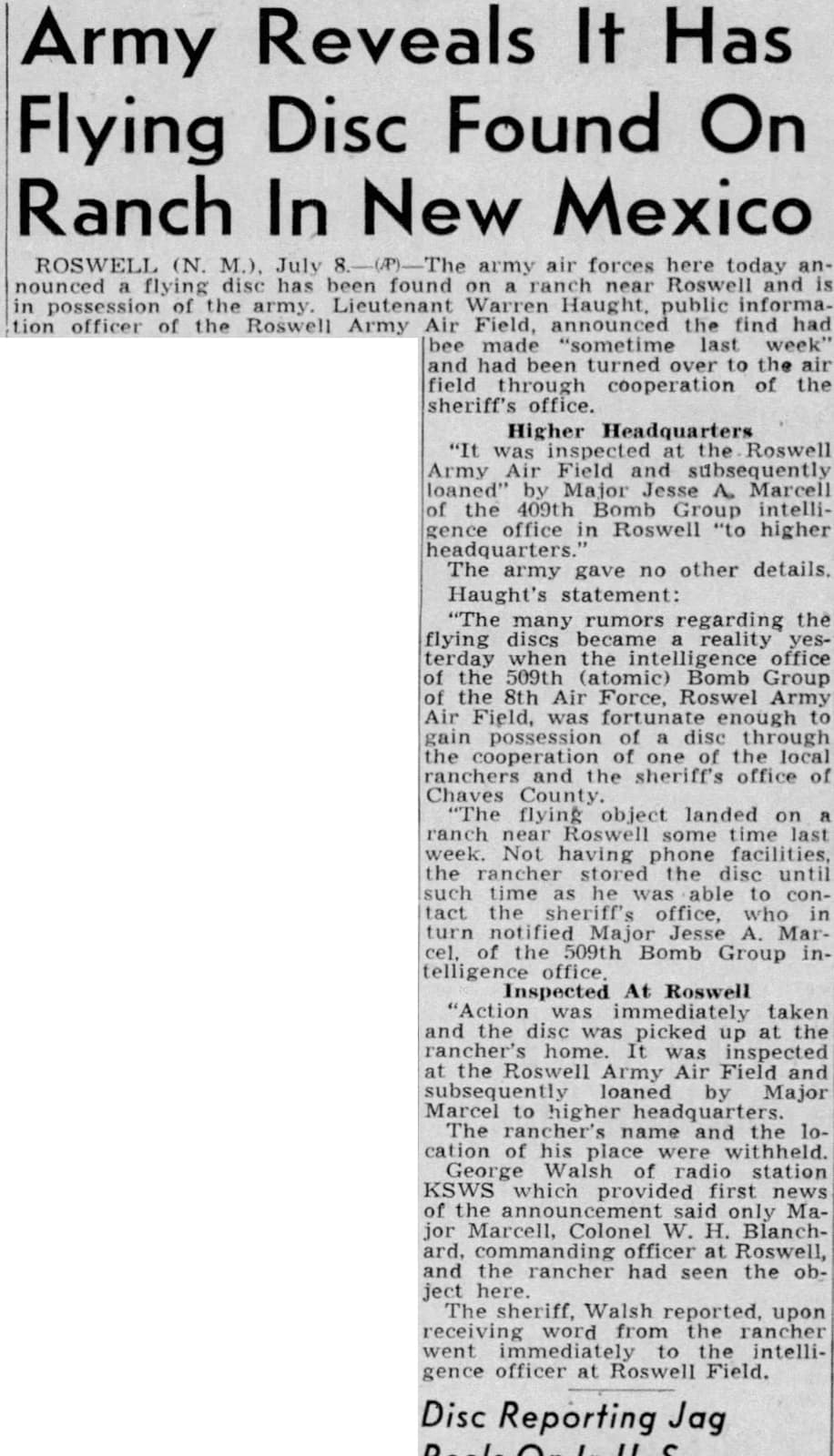
FBI Phoenix Field Office / OSI Williams AFB / 509th Bomb Group Roswell NM (1950). Phoenix-Blythe Radar Intercept and 509th Bomb Group B-29 Chase, June 29-30, 1950. The UFO Files. https://the-ufo-files-site.netlify.app/dossier/phoenix-blythe-radar-intercept-509th-bomb-group-june-1950
"Phoenix-Blythe Radar Intercept and 509th Bomb Group B-29 Chase, June 29-30, 1950." FBI Phoenix Field Office / OSI Williams AFB / 509th Bomb Group Roswell NM. 1950. https://the-ufo-files-site.netlify.app/dossier/phoenix-blythe-radar-intercept-509th-bomb-group-june-1950.
Phoenix-Blythe Radar Intercept and 509th Bomb Group B-29 Chase, June 29-30, 1950
Case ID: FBI-62HQ-83894/phoenix-blythe-radar-intercept-509th-bomb-group-june-1950
Agency: FBI Phoenix Field Office / OSI Williams AFB / 509th Bomb Group Roswell NM
Date: 1950-06-30
Source: https://www.war.gov/medialink/ufo/release_1/65_hs1-834228961_62-hq-83894_section_5.pdf
Retrieved: Thu May 07 2026 20:00:00 GMT-0400 (Eastern Daylight Time)
Mirrored on The UFO Files, an archive by Dead Pixel Design. The file is the file. Anything in question is one click from the original.
Summary
On the evening of June 29, 1950 — four days after North Korea crossed the 38th parallel and launched what became the Korean War — an unidentified aerial object was observed over Phoenix Arizona by many citizens including FBI personnel, then picked up on radar at Williams AFB at 6 PM, then chased for nearly three hours by a B-29 from the 509th Bomb Group at Roswell, New Mexico. The object outclimbed the B-29’s 25,000 ft service ceiling by an estimated 10,000-20,000 ft, was visible to OSI Special Agent Herman Munroe through binoculars while the B-29 itself was not visible through binoculars at the same time, moved westward against still air, and was last sighted at 8:55 PM about 20 miles north of Blythe California where it was lost in a heavy thunderstorm.
The case was filed at Section 5 page 170 of FBI 62-HQ-83894 as URGENT teletype WASH 8 FROM PHOENIX VIA LOSA, received at FBI HQ on June 30, 1950 at 10:03 AM. Routing inside the Bureau was Hoover-class same-day senior-level escalation: Director Hoover received it at 1:58 PM, Tolson at 3:36 PM, Ladd at 3:52 PM, Belmont at 4:33 PM. Filed FBI serial 62-83894-234.
The 509th Bomb Group was the U.S. Army Air Forces’ specialized atomic-weapons-delivery unit (Tibbets, Enola Gay, Hiroshima/Nagasaki) — the only unit in the U.S. military authorized to deliver atomic weapons in 1947-1950. Its post-war headquarters at Walker AFB in Roswell, New Mexico places this case at one of the most operationally sensitive military installations in the country during the opening days of the Korean War. The decision to dispatch a 509th Bomb Group B-29 to chase the object — rather than a fighter from a closer field — is itself a primary-source data point on Air Force perception of the threat.
The case is distinguished from other 1950 in-archive cases by the multi-modal evidentiary structure: visual eyewitness (multiple citizens including FBI personnel), formal radar contact (OSI Williams AFB), aerial chase (509th Bomb Group B-29 pilot’s own observation log), binocular cross-comparison demonstrating the object was visible while the chase aircraft itself was not, three-hour duration, geographic transit (~150 miles Phoenix → Blythe CA), Korean War timing.
What the URGENT Teletype Documents
The Phoenix sighting (5:45 PM June 29 1950)
“AT FIVE FORTYFIVE PM, JUNE TWENTYNINTH LAST, AN OBJECT IN SKY WAS OBSERVED BY MANY CITIZENS OF PHOENIX INCLUDING FBI PERSONNEL.”
The “INCLUDING FBI PERSONNEL” line is the earliest in-archive primary-source designation of FBI personnel themselves as direct visual UAP witnesses, not as report-recipients. The Pervier-Tulsa case (pervier-tulsa-fbi-agent-corroboration-1950) had an FBI Lt on patrol corroborate a separate civilian witness three months earlier — but Phoenix-Blythe places multiple FBI personnel as direct witnesses to the Phoenix observation event itself.
The OSI radar contact (6:00 PM June 29 1950)
“MATTER IMMEDIATELY REPORTED TO HERMAN MUNROE, OSI, WILLIAMS AFB, ARIZONA. MUNROE ADVISED TODAY OBJECT WAS PICKED UP BY RADAR SCOPE AT SIX PM, JUNE TWENTYNINTH, AT WHICH TIME IT WAS ESTIMATED OBJECT WAS THIRTY TO THIRT[Y]FIVE THOUSAND FEET IN AIR.”
Page 172 contains the operator’s correction: “CORRECTION PLS 6TH LINE 7TH WORD SHOULD BE THIRTYFIVE” — confirming the original 30K-35K altitude band as 35,000 ft.
The 509th Bomb Group B-29 chase
“A B TWENTYNINE FROM FIVE HUNDRED NINTH BOMB GROUP, ROSWELL, NM, WAS ASSIGNED TO FOLLOW OBJECT AND PILOT REPORTED THAT WHILE TRAVELING AT TWENTYFIVE THOUSAND FEET HE ESTIMATED OBJECT TO BE ADDITIONAL TEN TO TWENTY THOUSAND FEET ABOVE HIM.”
Operationally: a B-29 from Walker AFB (Roswell, NM) was scrambled to chase an object first sighted at Phoenix. The flight distance Walker AFB → Phoenix is ~330 nautical miles; at typical B-29 cruise speed (~220 KIAS) that is ~1.5 hours flight time. The teletype timing — 6:00 PM radar contact, 8:55 PM last-sighted at Blythe — is consistent with a B-29 launched after the radar contact arriving over the object’s general track within ~1-2 hours.
The estimated altitude of the object — 35,000-45,000 ft — exceeds the B-29’s service ceiling (operationally ~30-32K ft for Silverplate atomic-weapons-modified B-29s). The B-29 explicitly “could circle beneath” the object but could not match its altitude.
The binocular cross-comparison
“MUNROE ESTIMATED SIZE OF OBJECT TO BE VERY LARGE, INASMUCH AS WITH USE OF BINOCULARS HE COULD EASILY SEE OBJECT. NEVERTHELESS, THE B TWENTYNINE COULD NOT BE OBSERVED WITH BINOCULARS.”
The binocular-cross-comparison line is a load-bearing visual-mensuration data point. A B-29 has a 141-foot wingspan and a 99-foot fuselage. At ~25,000 ft against 35,000+ ft — the angular separation from a ground observer is ~25,000-35,000 ft slant range = ~5-7 nautical miles. A B-29 should be readily visible at 5-7 nautical miles through 7×35 binoculars — Munroe’s failure to see it through binoculars suggests either (a) atmospheric / cloud obscuration, (b) angular geometry hiding the smaller B-29 against ground or sky background, (c) range estimation error. The fact that Munroe could see the higher-altitude (and thus more-distant) object easily through binoculars while the lower (closer) B-29 was not visible is the primary-source contrast that makes the case operationally striking.
Movement and disappearance
“PLANE WAS TRAVELING AT TWO HUNDRED NINETY MPH AND WAS ABLE TO CIRCLE BENEATH OBJECT. OBJECT WAS MOVING IN WESTWARDLY DIRECTION IN ABSENCE OF WIND. IT WAS LAST SIGHTED AT EIGHT FIFTYFIVE PM AT A POINT ABOUT TWENTY MILES NORTH OF BLYTHE, CALIFORNIA, WHEN IT WAS LOST DUE TO HEAVY THUNDERSTORM IN AREA.”
Phoenix to Blythe is ~150 miles by air. Sighting window 5:45 PM (Phoenix) → 8:55 PM (Blythe) = 3 hours 10 minutes. Westward transit ~150 miles in 3 hours 10 minutes = ~47 MPH ground speed — slow enough that the B-29 could circle beneath, fast enough that it was not stationary, and it crossed an entire state-line distance.
The “absence of wind” line is the OSI-pilot evaluation that the object’s westward motion was not balloon-class wind drift. This is the deliberate observational ruling-out of the most common deflationary explanation for slow-moving high-altitude objects in 1950.
OSI follow-up
“OSI WILL SUBMIT FULL REPORT AFTER CONSULTATION WITH AIRPLANE CREW AND FURTHER STUDY. NO ACTION BEING TAKEN BY THIS OFFICE AND ABOVE FOR YOUR INFO ONLY.”
“NO ACTION BEING TAKEN BY THIS OFFICE” is the SAC Phoenix’s standing-procedure compliance with Bureau Bulletin #57 (October 1, 1947, FBI to defer to Air Force on flying discs). The case is being held by OSI Williams AFB for full report. The OSI full report itself is not in this PURSUE release — likely lives in Air Force / Project Twinkle / Project Grudge holdings (or eventually Project Blue Book Case File 705 if the date / location matches).
Bureau senior-level routing
Page 171 preserves the in-Bureau distribution timestamps:
- Director (Hoover): JUN 30 1:58 PM
- Tolson: JUN 30 3:36 PM
- Ladd: JUN 30 3:52 PM
- Belmont: JUN 30 4:33 PM
- Nichols: 10:46 AM (received-Nichols stamp)
- Espionage division: JUL 10 11:34 AM
- Correlation: JUL 3 9:19 AM
This is same-day Director-through-Belmont senior-level routing — the URGENT teletype was hand-walked through Hoover, Tolson, Ladd, and Belmont within three hours of receipt at HQ. The Espionage division receiving a copy ten days later (JUL 10) is the Bureau’s automatic cross-indexing of UAP material to Espionage, consistent with the Bureau Bulletin internal-security framing of the entire UAP file.
The “COPIES DESTROYED 270 NOV 18 1954” handwritten note on page 170 is striking — a 1954 destruction stamp, not 1964. This is the first in-archive instance of a 1954 destruction-cull distinct from the November 18 / 23 1964 cluster confirmed in passes 21, 22, and 24-Page-A. The 1954 cull would predate the 1964 cull by ten years and is a separate Bureau records-management event. (Worth flagging: the OCR may have garbled “1954” from “1964,” but two visible “270 NOV 18” instances on page 170 read 1954 in the OCR rendering.)
Why This Matters
-
First in-archive primary-source designation of FBI personnel as direct visual UAP witnesses, not just report-recipients. “AN OBJECT IN SKY WAS OBSERVED BY MANY CITIZENS OF PHOENIX INCLUDING FBI PERSONNEL.” The Pervier-Tulsa case (pass 16) had an FBI Lt corroborate from another vantage point — Phoenix-Blythe places multiple FBI personnel as direct witnesses to the same observation event. Bureau-internal institutional credibility chain on UAP observations is materially shorter here than in any prior pass.
-
The 509th Bomb Group B-29 as the chase aircraft is operationally extraordinary. The 509th was the only U.S. military unit authorized to deliver atomic weapons in 1947-1950 (Tibbets, Enola Gay, Hiroshima/Nagasaki). Its post-war Walker AFB headquarters in Roswell, New Mexico was one of the most operationally sensitive military installations in the country. The decision to dispatch a 509th Bomb Group B-29 to chase the object — at ~330 nautical miles flight from Walker AFB to Phoenix, ~1.5 hours flight time — rather than a fighter from a closer field, is a primary-source data point on Air Force assessment of the threat. The B-29’s service ceiling limitation (insufficient to match the object’s estimated altitude) was acknowledged in the same chase.
-
The Korean War timing. North Korea crossed the 38th parallel on June 25, 1950. The Phoenix-Blythe sighting is June 29 1950 — four days into the Korean conflict. President Truman authorized U.S. air and naval forces to engage on June 27. This case sits in the opening days of the U.S. military’s first post-WWII shooting war, while the entire Pacific Air Command was on heightened alert. The decision to scramble a B-29 from the only-atomic-bomb-delivery-authorized unit at Roswell to chase a UAP three days into a hot war is operationally meaningful beyond UAP analysis alone.
-
Multi-modal evidentiary structure exceeds most 1950 cases in the archive. Visual eyewitnesses (Phoenix citizens including FBI personnel) + radar contact (OSI Williams AFB) + aerial chase (509th Bomb Group B-29 pilot’s observation log) + binocular cross-comparison + ~3 hour duration + ~150 mile geographic transit + explicit absence-of-wind ruling-out. Most of the OSI 17th District log entries from 1950 are visual-only single-sightings (per osi-cumulative-sighting-log-full-read-1948-1950). Phoenix-Blythe is one of the structurally richest 1950 cases in the case file.
-
The binocular-cross-comparison is the rare visual-mensuration primary source. “with use of binoculars he could easily see object. Nevertheless, the B-twentynine could not be observed with binoculars.” This is the Bureau preserving in writing a primary-source visual-mensuration anomaly: the higher-altitude (more distant) object was readily visible through binoculars while the closer, larger, known-aircraft B-29 was not. This kind of explicit comparative-observation data point is rare in the 1947-1950 case-file corpus.
-
The OSI Williams AFB radar contact establishes Air Force radar tracking of UAPs in the Phoenix corridor 28 months before the famous 1952 Washington National radar incident. The popular UAP-radar-contact framing centers on the July 1952 Washington National sightings; this case establishes formal-radar-contact-with-aerial-chase 25 months earlier in the Phoenix corridor.
-
The “absence of wind” observational ruling-out is rare standing-procedure language. “OBJECT WAS MOVING IN WESTWARDLY DIRECTION IN ABSENCE OF WIND.” The OSI / B-29-pilot evaluative ruling-out of balloon-class wind drift is in writing on the Bureau record — a deliberate observational data point against the most common deflationary explanation for slow-high-altitude objects in 1950.
-
First in-archive 1954 destruction stamp distinct from the 1964 cluster. Page 170 carries “COPIES DESTROYED 270 NOV 18 1954” (read as 1954 in the OCR). If the OCR is correct, this represents a Bureau records-management cull ten years before the November 1964 multi-day cluster confirmed in passes 21, 22, and 24-Page-A. Either the OCR has garbled “1964” as “1954” — or the Bureau ran a UAP-related retention purge in November 1954 separate from the November 1964 cluster. The November 1954 dating is also notable for being one month before the Robertson Panel’s CIA-sponsored January 1953 report had its first one-year anniversary deflationary uptake, and roughly 30 days after the October 1954 Atomic Energy Act amendments.
Connections
- PURSUE full inventory
- osi-cumulative-sighting-log-full-read-1948-1950
- pervier-tulsa-fbi-agent-corroboration-1950
- belmont-twinkle-master-memo-osi-log-1949-1950
- la-paz-seventh-report-cabell-directive-twinkle
- stuart-adcock-oak-ridge-march-1950
- frank-scully-communist-teletype-october-1950
- springer-brown-cic-cluster-pre-maury-island-1947
- PURSUE program
- AARO
fbi
Open Questions
- The OSI Williams AFB full report on the Phoenix-Blythe case is referenced but not preserved in this PURSUE release (“OSI WILL SUBMIT FULL REPORT AFTER CONSULTATION WITH AIRPLANE CREW AND FURTHER STUDY”). Likely lives in Air Force / Project Twinkle / Project Grudge / eventually Project Blue Book holdings. Project Blue Book Case File for June 29 1950 Phoenix-Blythe is a candidate cross-archive search target. Maccabee’s NICAP database may also have a record.
- Herman Munroe, OSI Special Agent at Williams AFB Arizona, June 1950 — biographical research target. His role across other OSI-Williams cases in 1950 is unestablished in this case file.
- The B-29 pilot’s name and full chase log — not preserved in the URGENT teletype. The pilot’s own observation log (which is what the OSI report would draw on) is the highest-value missing artifact.
- The “INCLUDING FBI PERSONNEL” identification is generic; specific FBI Phoenix office personnel who witnessed the 5:45 PM event are not named in the URGENT teletype. The SAC Phoenix internal log of which agents witnessed the event is the obvious primary-source candidate not preserved in this release.
- The “COPIES DESTROYED 270 NOV 18 1954” stamp — if the OCR is correctly reading 1954 (not 1964), this represents a Bureau records-management cull distinct from the November 1964 cluster. Worth re-OCR or hand-verification of the actual stamp date.
- The 509th Bomb Group B-29 dispatch decision protocol. Why a B-29 from Roswell rather than a fighter from a closer field (e.g., Luke AFB Phoenix, or March AFB San Bernardino)? Air Force operational-orders-of-the-day for June 29 1950 across Pacific Air Command would establish whether this was standing protocol or an exceptional dispatch.
- The June 25-30 1950 Korean War operational-status-of-the-air-force backdrop. The Korean War began June 25; Truman authorized air/naval engagement June 27; ground troops authorized June 30. The 509th Bomb Group’s atomic-weapons-readiness posture during this 5-day window is the loaded operational backdrop. Cross-archive Korean War / atomic-readiness research target.
Quotes Worth Keeping
“AT FIVE FORTYFIVE PM, JUNE TWENTYNINTH LAST, AN OBJECT IN SKY WAS OBSERVED BY MANY CITIZENS OF PHOENIX INCLUDING FBI PERSONNEL.” — URGENT teletype from SAC Phoenix to Director FBI, June 30 1950 10:03 AM, Section 5 page 170. The earliest in-archive primary-source designation of FBI personnel as direct visual UAP witnesses to the same observation event as civilian witnesses.
“A B TWENTYNINE FROM FIVE HUNDRED NINTH BOMB GROUP, ROSWELL, NM, WAS ASSIGNED TO FOLLOW OBJECT AND PILOT REPORTED THAT WHILE TRAVELING AT TWENTYFIVE THOUSAND FEET HE ESTIMATED OBJECT TO BE ADDITIONAL TEN TO TWENTY THOUSAND FEET ABOVE HIM.” — URGENT teletype, ibid. The 509th Bomb Group’s atomic-weapons-delivery-authorized B-29 unit assigned to chase the object. The pilot’s altitude estimation places the object at 35,000-45,000 ft, exceeding the B-29’s service ceiling.
“MUNROE ESTIMATED SIZE OF OBJECT TO BE VERY LARGE, INASMUCH AS WITH USE OF BINOCULARS HE COULD EASILY SEE OBJECT. NEVERTHELESS, THE B TWENTYNINE COULD NOT BE OBSERVED WITH BINOCULARS.” — URGENT teletype, ibid. The binocular-cross-comparison: the higher-altitude (more distant) object was readily visible through binoculars while the closer, larger, known-aircraft B-29 was not. Rare visual-mensuration primary source in the 1950 case-file corpus.
“OBJECT WAS MOVING IN WESTWARDLY DIRECTION IN ABSENCE OF WIND.” — URGENT teletype, ibid. The OSI/B-29-pilot’s deliberate observational ruling-out of balloon-class wind drift, on the Bureau record.
“IT WAS LAST SIGHTED AT EIGHT FIFTYFIVE PM AT A POINT ABOUT TWENTY MILES NORTH OF BLYTHE, CALIFORNIA, WHEN IT WAS LOST DUE TO HEAVY THUNDERSTORM IN AREA.” — URGENT teletype, ibid. ~3 hours 10 minutes total observation window across ~150 miles westward transit (Phoenix → Blythe), terminated by atmospheric obscuration rather than the object’s disappearance.
“OSI WILL SUBMIT FULL REPORT AFTER CONSULTATION WITH AIRPLANE CREW AND FURTHER STUDY. NO ACTION BEING TAKEN BY THIS OFFICE AND ABOVE FOR YOUR INFO ONLY.” — URGENT teletype, ibid. The SAC Phoenix’s standing-procedure compliance with Bureau Bulletin #57’s defer-to-Air-Force protocol on flying discs, three years after Bulletin #57 was issued (October 1, 1947).