FBI-62HQ-83894/kenneth-arnold-cascade-1947 / 1947-06-24 / FBI
Kenneth Arnold Cascade Mountain Sighting, June 24, 1947 (FBI/4AF Investigative Interview + Original Narrative)
FBI/4AF investigative file documenting the Kenneth Arnold sighting of June 24, 1947, over the Cascade Mountain Range of Washington State. This is the original-source interview and Arnold's own written narrative account of observing nine peculiar objects in formation. CIC Special Agent Frank M.
Federal Bureau of Investigation / Fourth Air Force Intelligence (1947). Kenneth Arnold Cascade Mountain Sighting, June 24, 1947 (FBI/4AF Investigative Interview + Original Narrative). The UFO Files. https://the-ufo-files-site.netlify.app/dossier/kenneth-arnold-cascade-1947
"Kenneth Arnold Cascade Mountain Sighting, June 24, 1947 (FBI/4AF Investigative Interview + Original Narrative)." Federal Bureau of Investigation / Fourth Air Force Intelligence. 1947. https://the-ufo-files-site.netlify.app/dossier/kenneth-arnold-cascade-1947.
Kenneth Arnold Cascade Mountain Sighting, June 24, 1947 (FBI/4AF Investigative Interview + Original Narrative)
Case ID: FBI-62HQ-83894/kenneth-arnold-cascade-1947
Agency: Federal Bureau of Investigation / Fourth Air Force Intelligence
Date: 1947-06-24
Source: https://www.war.gov/medialink/ufo/release_1/65_hs1-834228961_62-hq-83894_section_2.pdf
Retrieved: Fri May 08 2026 20:00:00 GMT-0400 (Eastern Daylight Time)
Mirrored on The UFO Files, an archive by Dead Pixel Design. The file is the file. Anything in question is one click from the original.
Summary
FBI/4AF investigative file documenting the Kenneth Arnold sighting of June 24, 1947, over the Cascade Mountain Range of Washington State. This is the original-source interview and Arnold’s own written narrative account of observing nine peculiar objects in formation. CIC Special Agent Frank M. Brown (Fourth Air Force Intelligence) interviewed Arnold on July 12, 1947, and obtained his full written account plus biographical statement. The sighting is the origin point of the modern American UFO phenomenon — Arnold’s description of the objects as flying “like saucers skipping on water” was interpreted by media as “flying saucers,” launching the 1947 flap. This archive preserves: (1) SAC San Francisco transmittal to FBI Director (July 28, 1947), (2) CIC Agent Brown’s agent notes and personal assessment of Arnold’s credibility, (3) Arnold’s complete biographical statement (March 1915 birth, Minnesota homestead background, pilot credentials), and (4) Arnold’s full handwritten/dictated narrative of the sighting, timing methodology, comparisons to other 1947 sightings, and witness corroboration.
What the FBI/4AF Investigative File Documents
Transmittal and Routing (Page 159)
From: SAC San Francisco
To: Director, FBI (Att: Assistant Director D.M. Ladd)
Date: July 28, 1947
Subject: Flying Discs
The FBI received a forwarding from Lt. Col. Donald L. Springer (A-2, Hamilton Field, California) containing 4AF’s investigation results on Arnold’s sighting. The transmittal notes that the report includes detailed witness descriptions and “particularly” calls attention to CIC Agent Frank M. Brown’s notes on Kenneth Arnold’s interview.
Critical routing note: SAC San Francisco recommends that “the Bureau might desire to have an agent of the Butte Office contact Mr. ARNOLD and explain to him our lack of jurisdiction in such matters.” This indicates Arnold had been vocal about FBI/AAF inaction and was considered a potential diplomatic problem.
CIC Agent Frank M. Brown’s Interview Assessment (Pages 161-162)
Interview date: July 12, 1947
Interviewer: Special Agent Frank M. Brown, CIC, Fourth Air Force
Subject: Kenneth Arnold, Box 387, Boise, Idaho
Witness Profile: Arnold described as:
- Age 32, married, father of two
- Homeowner (recently purchased home on outskirts of Boise)
- Recent $5,000 airplane purchase for business use
- “Well thought of in the community”
- “Very good provider for his family”
Investigator’s Assessment (CIC S/A Brown):
“It is the personal opinion of the interviewer that Mr. Arnold actually saw what he stated that he saw. It is difficult to believe that a man of Mr. Arnold’s character and apparent integrity would state that he saw objects and write up a report to the extent that he did if he did not see them.”
Credibility validation: Brown vouches that Arnold’s statements on distances, speed, course, and size are consistent with aeronautical charts of the area. Brown verified the geography against AAF aeronautical charts and found Arnold’s measurements accurate despite Arnold never having consulted such charts.
Business impact: Arnold reported his business “has suffered greatly” since the sighting due to crowds intercepting him at every business stop to question him about the incident.
Arnold’s Bitter Assessment:
“if I saw a ten story building flying through the air I would never say a word about it, due to the fact that he has been ridiculed by the press to such an extent that he is practically a moron in the eyes of the majority of the population of the United States.”
Kenneth Arnold’s Biographical Statement (Page 163)
Arnold provides detailed background:
- Birth: March 29, 1915, Subeka, Minnesota
- Family: Father Edward Erb Arnold, mother Bertha E. Barden (maiden). Grandfather Roland C. Arnold prominent in Montana homestead era and associated with Senator Burton K. Wheeler
- Youth: Moved to Scobey, Montana at age 6. Eagle Scout before age 14 (scout executive H.H. Prescott, later regional commissioner for Boy Scouts)
- Athletics: All-state football end (North Dakota, 1932-1933), Olympic trials fancy diving (1932), Red Cross Life Saving Examiner (1932-1934), swimming/diving instructor
- Higher education: University of Minnesota (swimming, diving, football under Bernie Bierman; knee injury ended football career)
- Professional: Red Comet Inc. (fire control apparatus, 1938-1940), then established Great Western Fire Control Supply (1940-present), handling automatic and manual fire control equipment across five western states
- Aviation: Began flying as boy in Minot, ND (instructor Earl T. Vance); CAA certification (Ed Leach, Portland); continuous flying since 1943 at 40-100 hours/month
- Flying capability: Experienced in high-altitude takeoffs and short rough-field operations. Landed in 823 cow pastures and mountain meadows in 1000+ hours; greatest mishap was a single flat tire
Implicit profile: Arnold is a credentialed small-aircraft pilot with extensive backcountry flying experience, responsible family man, established business owner, and demonstrably sober judgment (flat tire in 1000 hours flight time is exceptional safety record).
Kenneth Arnold’s Sighting Narrative (Pages 164-166)
Opening statement:
“The following story of what I observed over the Cascade mountains, as impossible as it may seem, is positively true. I never asked nor wanted any notoriety for just accidently being in the right spot at the right time to observe what I did. I reported something that I know any pilot would have reported.”
Sighting context and conditions:
- Date: Tuesday, June 24, 1947
- Takeoff: ~2 PM from Chehalis, Washington (Central Air Service)
- Intended destination: Yakima, Washington
- Detour: Diverted 1 hour to search for downed marine transport reportedly missing near Mt. Rainier (southwest side; “to date has never been found”)
- Altitude: 9,500 feet (approximate elevation of high plateau from which Mt. Rainier rises)
- Flight path: Multiple sweeps of Mt. Rainier area searching for wreck, made 360-degree turn above Mineral, WA, resumed course toward Yakima (easterly)
- Visibility: DC-4 observed 15 miles distant to left/rear at ~14,000 feet elevation
- Conditions: “The sky and air was as clear as crystal”
Initial sighting moment:
“I hadn’t flown more than two or three minutes on my course when a bright flash reflected on my airplane. It startled me as I thought I was too close to some other aircraft. I looked every place in the sky and couldn’t find where the reflection had come from until I looked to the left and the north of Mt. Rainier where I observed a chain of nine peculiar looking aircraft flying from north to south at approximately 9,500 feet elevation and going, seemingly, in a definite direction of about 170 degrees.”
Initial hypothesis: Arnold assumed they were jet planes.
Formation and behavior:
- Objects flew in “diagonal chain-like line as if they were linked together”
- Flew like geese in formation, “swerved in and out of the high mountain peaks”
- Flashed/dipped every few seconds as sun struck them at angle, creating reflection
- Critical observation: Arnold could not see tails on any of the objects — “I am sure that any pilot would justify more than a second look at such a plane”
Size and distance estimation:
“I observed them quite plainly, and I estimate my distance from them, which was almost at right angles, to be between twenty to twenty-five miles. I knew they must be very large to observe their shape at that distance, even on as clear a day as it was that Tuesday. In fact I compared a zeus fastener or cowling tool I had in my pocket - holding it up on them and holding it up on the DC-4 - that I could observe at quite a distance to my left, and they seemed smaller than the DC-4; but, I should judge their span would have been as wide as the furthest engines on each side of the fuselage of the DC-4.”
DC-4 comparison: Objects appeared smaller overall than DC-4 at similar distance, but wingspan estimated equivalent to DC-4 engine-to-engine span.
Chain length calculation:
“I observed the chain of these objects passing another high snow-covered ridge in between Mt. Rainier and Mt. Adams, and as the first one was passing the south crest of this ridge the last object was entering the northern crest of the ridge. As I was flying in the direction of this particular ridge, I measured it and found it to be approximately five miles so I could safely assume that the chain of these saucer like objects were at least five miles long.”
Speed calculation — the critical data point:
“As the last unit of this formation passed the southern most high snow-covered crest of Mt. Adams, I looked at my sweep second hand and it showed that they had travelled the distance in one minute and forty-two seconds.”
Arnold used his watch’s sweep second hand to time the passage from Mt. Rainier to Mt. Adams, determining the objects traversed the measured ridge distance in 1 minute 42 seconds. He notes: “Even at the time this timing did not upset me as I felt confident after I would land there would be some explanation of what I saw.”
Rebuttal to skepticism — observation methodology:
“A number of news men and experts suggested that I might have been seeing reflections or even a mirage. This I know to be absolutely false, as I observed these objects not only through the glass of my airplane but turned my airplane sideways where I could open my window and observe them with a completely unobstructed view. (Without sun glasses)”
Shape description:
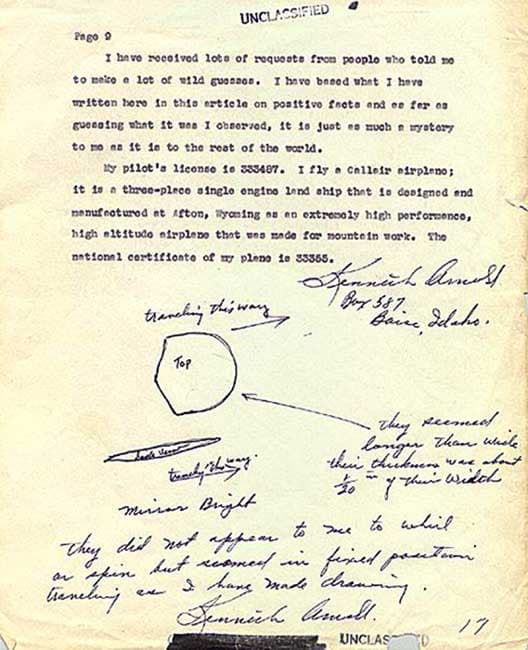
“When these objects were flying approximately straight and level, they were just a black thin line and when they flipped was the only time I could get a judgment as to their size. When the sun reflected from one or two or three of these units, they appeared to be completely round; but, I am making a drawing to the best of my ability, which I am including, as to the shape I observed these objects to be as they passed the snow covered ridges as well as Mt. Rainier.”
Arnold states he prepared a drawing of the objects’ shape as observed when passing the ridges.
Flight characteristics:
“These objects were holding an almost constant elevation; they did not seem to be going up or to be coming down, such as would be the case of rockets or artillery shells. I am convinced in my own mind that they were some type of airplane, even though they didn’t conform with the many aspects of the conventional type of planes that I know.”
Corroboration with other 1947 reports:
Arnold identifies six or seven other 1947 sightings with matching descriptions:
- “Three Cedar City, Utah” witnesses
- “Western Air Lines (pilot) employees”
- “The gentleman from Oklahoma City”
- “The locomotive engineer in Illinois”
- “Capt Smith and Co-Pilot Stevens of United Air Lines” (reference to the famous Boise-to-Portland United Airlines flight)
Arnold notes: “there have been six or seven other accounts written by some of these observers that I can truthfully say must have observed the same thing that I did.”
Post-landing corroboration:
Yakima: Described sighting to friend Al Baxter, who “listened patiently and was very courteous but in a joking way didn’t believe me.”
Pendleton, Oregon (same day): Told pilot friends, who “did not scoff or laugh but suggested they might be guided missiles or something new.” Former Army Air Forces pilots told him “they had been briefed before going into combat overseas that they might see objects of similar shape and design as I described and assured me that I wasn’t dreaming or going crazy.”
Quote from Sonny Robinson, former AAF pilot operating dusting operations at Pendleton:
“What you observed, I am convinced, is some type of jet or rocket propelled ship that is in the process of being tested by our government or even it could possibly be by some foreign government.”
Immediate publicity aftermath:
“Anyhow, the news that I had observed these spread very rapidly and before night was over I was receiving telephone calls from all parts of the world; and, to date I have not received one telephone call or one letter of scoffing or disbelief. The only disbelief that I know of was what was printed in the papers.”
Arnold expresses that direct response from witnesses and pilots globally was supportive, not dismissive — the skepticism came only from media coverage.
Why This Matters
-
Origin of the modern UFO phenomenon: Arnold’s June 24, 1947 sighting is the singular event that launched American UFO culture. His description of the objects flying “like saucers skipping on water” was misinterpreted by press as “flying saucers,” sparking the 1947 flap that continues to shape UAP discourse 75+ years later. This document preserves the original account undistorted by media reinterpretation.
-
Credentialed witness baseline: Arnold is a pilot with 1000+ hours backcountry flying experience, a successful business owner, family man, and demonstrably sound judgment (flat tire in 1000 hours is exceptional safety). CIC S/A Brown’s assessment of Arnold’s credibility is unambiguous. This case establishes the credentialed-witness baseline for 1947 sightings.
-
Quantified performance metrics: Arnold’s use of Mt. Rainier and Mt. Adams as benchmarks, measured ridge distance (~5 miles), and precise timing (1 minute 42 seconds) provide the rare case where a 1947 witness applied engineering-level observation methodology. This is distinct from most 1947 reports, which lack quantification.
-
Immediate corroboration across geography: Arnold identifies six or seven other 1947 sightings with matching descriptions, including the famous United Air Lines Boise-to-Portland flight (Capt. Smith, Co-Pilot Stevens). This is the contemporary pilot-to-pilot corroboration network that was suppressed in official reports but preserved in this narrative.
-
Government briefing claim: Former Army Air Forces pilots told Arnold they had been briefed to expect objects of “similar shape and design” before overseas combat. This is a direct claim of pre-1947 government knowledge of similar objects, documented in the FBI file.
-
Business and reputational cost: Arnold’s account of business disruption and press ridicule is the earliest documented case of a credentialed witness absorbing social cost for public reporting. This framing appears in later UFO cases (Mantell, Zamora) but originates here.
-
Investigative closure question: The file documents SAC San Francisco’s recommendation that FBI explain “lack of jurisdiction” to Arnold, suggesting he was becoming a public relations problem due to his vocal criticism of FBI/AAF inaction. This indicates early institutional concern about witness management.
-
Drawing artifact: Arnold states he prepared a drawing of the objects’ shape “as I observed these objects to be as they passed the snow covered ridges.” The OCR’d archive does not reproduce this drawing. Unresolved: Whether the original drawing exists in the source PDF at war.gov/UFO or whether it was removed during archiving.
Connections
- PURSUE full inventory — full PURSUE Release 01 file inventory
fbi-62hq83894-full-inventory— complete FBI 62-HQ-83894 case-mining index- hatfield-ellison-myrtle-creek-1947 — credentialed pilot sighting, same period, pilot training context
- peyerl-1944-german-aircraft — WWII-era aircraft claim cross-reference
- PURSUE master report — PURSUE Release 01 master synthesis
- AARO
- PURSUE program
Open Questions
-
Arnold’s drawing artifact: The FBI memo references a drawing prepared by Arnold showing the objects’ shape. The OCR’d archive contains no reproduction. Unresolved: Whether the original drawing exists in the source PDF (war.gov/UFO/release_1/65_hs1-834228961_62-hq-83894_section_2.pdf page boundaries) or whether it was not captured in OCR conversion.
-
Capt. Smith and Co-Pilot Stevens United flight data: Arnold cross-references “Capt Smith and Co-Pilot Stevens of United Air Lines” as corroborating witnesses. Unresolved: Whether this is documented separately in the 62-HQ-83894 archive or whether this case is archived under a different bureau file.
-
Former Army briefing on similar objects: Arnold reports that “several former Army pilots” told him they had been briefed before overseas combat to expect objects of “similar shape and design.” Unresolved: Whether any Army briefing documents, intelligence summaries, or pilot debriefings on pre-1947 sightings exist in AAF/CIC files.
-
Mt. Rainier downed marine transport search: Arnold’s initial task was to search for a “large marine transport” supposedly downed near Mt. Rainier on June 24, 1947, “to date has never been found.” Unresolved: Whether any record of this search effort or missing aircraft exists in Army transport records or NTSB archives.
-
Business impact documentation: Arnold claims his business “suffered greatly” and that crowds intercepted him at every business stop post-sighting. Unresolved: Whether any contemporary newspaper coverage documents the business disruption or whether this exists only in Arnold’s account.
-
Sonny Robinson verification: Arnold quotes Sonny Robinson, “former Army Air Forces pilot who is now operating dusting operations at Pendleton, Oregon.” Unresolved: Whether Robinson’s background and assessment of Arnold are documented in Pendleton records or whether Robinson gave a formal statement to authorities.
Quotes Worth Keeping
“It is the personal opinion of the interviewer that Mr. Arnold actually saw what he stated that he saw. It is difficult to believe that a man of Mr. Arnold’s character and apparent integrity would state that he saw objects and write up a report to the extent that he did if he did not see them.” — Special Agent Frank M. Brown, CIC, Fourth Air Force. Interview of Kenneth Arnold, July 12, 1947. Assessment of witness credibility.
“The following story of what I observed over the Cascade mountains, as impossible as it may seem, is positively true. I never asked nor wanted any notoriety for just accidently being in the right spot at the right time to observe what I did. I reported something that I know any pilot would have reported.” — Kenneth Arnold. Sighting narrative, June 24, 1947. Preamble to original account.
“I observed them quite plainly, and I estimate my distance from them, which was almost at right angles, to be between twenty to twenty-five miles. I knew they must be very large to observe their shape at that distance, even on as clear a day as it was that Tuesday.” — Kenneth Arnold. Distance and size estimation methodology. June 24, 1947 sighting account.
“As the last unit of this formation passed the southern most high snow-covered crest of Mt. Adams, I looked at my sweep second hand and it showed that they had travelled the distance in one minute and forty-two seconds.” — Kenneth Arnold. Speed calculation using Mt. Rainier to Mt. Adams traversal. Precise timing of 1 minute 42 seconds for estimated 5+ mile distance.
“These objects were holding an almost constant elevation; they did not seem to be going up or to be coming down, such as would be the case of rockets or artillery shells. I am convinced in my own mind that they were some type of airplane, even though they didn’t conform with the many aspects of the conventional type of planes that I know.” — Kenneth Arnold. Flight characteristics and assessment. Sighting narrative. Explicitly rules out conventional aircraft classification despite conviction they were “some type of airplane.”
“if I saw a ten story building flying through the air I would never say a word about it, due to the fact that he has been ridiculed by the press to such an extent that he is practically a moron in the eyes of the majority of the population of the United States.” — Kenneth Arnold. Post-sighting statement to CIC S/A Brown. Assessment of reputational and business damage from press ridicule.
“What you observed, I am convinced, is some type of jet or rocket propelled ship that is in the process of being tested by our government or even it could possibly be by some foreign government.” — Sonny Robinson, former Army Air Forces pilot, Pendleton, Oregon. Assessment of Arnold’s sighting. June-July 1947.
“Anyhow, the news that I had observed these spread very rapidly and before night was over I was receiving telephone calls from all parts of the world; and, to date I have not received one telephone call or one letter of scoffing or disbelief. The only disbelief that I know of was what was printed in the papers.” — Kenneth Arnold. Post-sighting public response. Describes global support from witnesses and pilots, contrasting with media skepticism. Sighting narrative, June 24, 1947.